
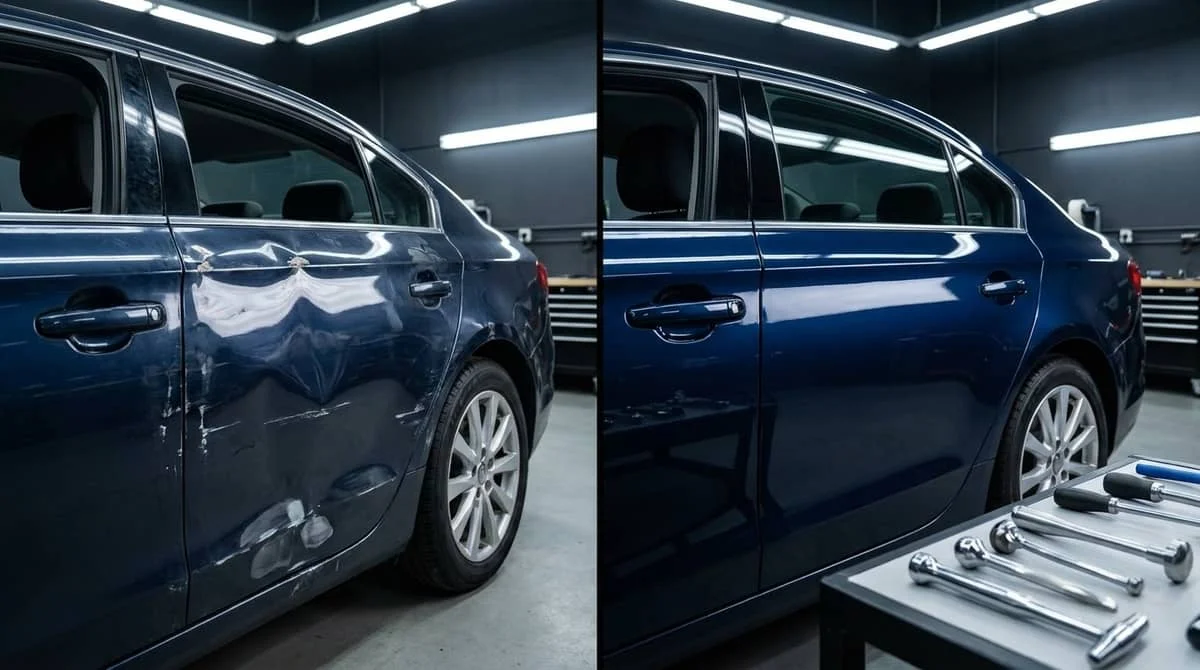
The most common dent repair mistakes happen when vehicle owners act too quickly, wait too long, or choose a repair method without understanding the damage. Pulling a dent with the wrong tool, applying uncontrolled heat, ignoring cracked paint, or taking a collision-damaged vehicle to the wrong type of repair facility can turn a manageable dent into a more expensive problem.
Knowing what not to do after a car dent is just as important as knowing how dents are professionally repaired. Many door dings, hail dents, and minor body-panel dents qualify for Paintless Dent Repair, but only when the paint, metal, and panel structure are suitable for the process.
Below are the biggest mistakes people make with dent repair, why they cause problems, and how to choose a safer repair option.
What Are the Most Common Dent Repair Mistakes?
The most common dent repair mistakes include:
- Trying an unsuitable DIY repair method
- Pulling too hard and creating high spots
- Applying excessive or uncontrolled heat
- Ignoring chipped or cracked paint
- Waiting too long to repair dents
- Assuming every dent qualifies for PDR
- Choosing a body shop or dent specialist based only on price
- Failing to inspect hidden collision damage
- Filing or avoiding an insurance claim without comparing the costs
- Accepting a repair without checking the panel under proper lighting
These dent repair errors can damage the factory finish, stretch the metal, increase labor time, reduce repairability, and affect the vehicle’s resale value.

Mistake 1: Attempting DIY Dent Repair Without Assessing the Damage
Consumer repair kits often make dent removal look simple: attach a puller, apply pressure, and watch the panel return to its original shape. In practice, vehicle body panels react differently depending on the dent’s depth, location, impact angle, panel material, paint condition, and internal bracing.
Common DIY dent repair mistakes include:
- Pulling from the wrong point
- Using a tab that is too large or too small
- Applying uneven force
- Pulling a dent before releasing surrounding tension
- Working without reflective PDR lighting
- Attempting repairs on cracked or repainted surfaces
- Continuing after the metal begins to distort
A panel is not simply pushed inward at the center of a dent. The impact also creates pressure and tension around the damaged area. Professional technicians manage both the low area and the surrounding crowns. Pulling only the center may improve the dent temporarily while leaving ripples, raised areas, or an uneven reflection.
When Not to Use a Dent Repair Kit
Avoid an at-home dent repair kit when:
- The paint is chipped, cracked, or peeling.
- The dent has a sharp center.
- The metal is deeply creased.
- The damage crosses a complex bodyline.
- The panel has been repainted.
- The dent sits near an edge or structural reinforcement.
- The panel is aluminum and you lack appropriate training.
- The damage followed a collision.
- Sensors, trim, glass, or adjacent components are affected.
Admire PDR’s comparison of professional PDR and DIY kits notes that improper pulling can create high spots, stretch metal, damage paint, and increase the cost of professional correction.

Mistake 2: Over-Pulling the Dent
One of the most frequent dent puller mistakes is applying too much force.
Metal must be moved gradually and precisely. A strong pull may bring the center outward too far, creating a raised area known as a high spot. The original dent may then be replaced by a visible bump, wave, or distorted bodyline.
Over-pulling can also:
- Stretch the sheet metal
- Crack the clear coat
- Weaken previous paintwork
- Create multiple secondary low spots
- Make the surface harder to finish
- Reduce the likelihood of a clean paintless repair
Professional PDR relies on many small, controlled movements rather than one aggressive pull. Technicians continually read the panel through specialized reflection boards or line lights so they can identify subtle highs and lows that are difficult to see under ordinary garage lighting.
Mistake 3: Assuming Suction Cups Work on Every Dent
A suction cup may move a large, shallow depression on a relatively flat panel, but it is not a universal dent-removal tool.
Common suction cup dent repair mistakes include using suction on:
- Small dents that do not provide enough contact area
- Sharp dents
- Creases
- Bodyline damage
- Hail dents
- Dents near panel edges
- Panels with complex curves
Suction acts across a broad area and offers limited control over the exact point where the metal needs correction. Even when the panel “pops,” the repair may leave subtle distortion around the impact zone.
A suction cup also cannot correct paint damage, torn metal, broken brackets, or hidden collision problems.

Mistake 4: Using Glue Pulling on Unsuitable Paint
Glue-pull repair is a legitimate professional PDR technique. A technician attaches specially selected tabs to the exterior surface, allows the adhesive to set, and uses controlled pulling force to raise the damaged metal.
The method becomes risky when performed without checking the paint.
Common glue pull dent repair mistakes include:
- Pulling on a repainted panel
- Using excessive adhesive
- Choosing the wrong tab shape
- Allowing glue to become too hot
- Pulling at the wrong angle
- Removing tabs improperly
- Repeating aggressive pulls in one location
Factory paint is generally more predictable than unknown aftermarket paint, but no painted surface should be treated as risk-free. Weak adhesion between prior paint layers can lead to paint lifting or clear-coat separation.
Professional technicians inspect the finish and ask about previous repairs before using glue-pull methods. This is one reason DIY dent removal gone wrong can require repainting even when the original dent might have qualified for PDR.
Mistake 5: Applying Boiling Water, a Heat Gun, or Dry Ice
Online repair videos frequently recommend boiling water, hair dryers, heat guns, compressed air, or dry ice. These methods offer little control over panel temperature or metal movement.
Excessive heat can:
- Soften or discolor paint
- Damage clear coat
- Distort plastic parts
- Affect adhesives and seam sealers
- Create uneven expansion
- Harm nearby trim or electronics
Rapid heating and cooling may also place unnecessary stress on the finish. Modern vehicles combine steel, aluminum, plastics, adhesives, sensors, and multilayer paint systems. A technique that appears to work on one bumper cover may be unsuitable for a painted metal door or aluminum hood.
Controlled heat is sometimes used in professional PDR, particularly with aluminum or deep damage, but technicians regulate temperature and continuously monitor the finish. It is not equivalent to pouring boiling water over a panel or holding a heat gun close to the paint.

Mistake 6: Ignoring Small Dents or Waiting Too Long
Another major error is waiting too long to repair dents because the damage appears cosmetic.
A stable dent with intact paint may not suddenly expand on its own, but delayed repair can still create problems. If the impact chipped the paint or exposed metal, moisture can reach the substrate and initiate corrosion. Dirt, road salt, and repeated weather exposure can accelerate the process.
Potential consequences of untreated car dents include:
- Rust around chipped paint
- Clear-coat deterioration
- Corrosion beneath the surface
- Lower resale or trade-in value
- More extensive refinishing
- Reduced PDR repairability after further damage
So, can dents get worse? The metal deformation may remain similar, but the surrounding paint and exposed substrate can deteriorate. A second impact in the same area can also create more complex damage.
Admire PDR recommends addressing small dents before paint failure or corrosion turns a paintless repair into conventional bodywork.
Mistake 7: Assuming Every Dent Can Be Fixed with PDR
Paintless Dent Repair is highly effective, but it is not appropriate for every type of damage.
PDR works best when:
- The paint remains intact.
- The metal is not excessively stretched.
- The technician can reach or safely pull the damaged area.
- The dent does not involve torn metal.
- The panel and underlying structure remain repairable.
- The damage is primarily cosmetic.
Traditional repair may be necessary when:
- Paint is missing or severely cracked.
- The panel has deep, sharp deformation.
- Metal is torn or heavily stretched.
- Structural components are damaged.
- A panel requires welding or replacement.
- Prior filler or poor repainting affects the repair area.
Admire PDR describes PDR as most suitable for small-to-medium dents with intact paint, including many door dings and hail dents, while severe collision damage usually requires conventional auto body repair.

PDR vs. Body Shop: Choosing the Right Dent Repair
Choosing between PDR vs. body shop repair depends on the condition of the paint, metal, structure, and related components—not simply the dent’s diameter.
| Repair consideration | Paintless Dent Repair | Traditional body repair |
| Factory paint intact | Usually preferred | Often unnecessary |
| Chipped or missing paint | Cannot restore paint | Can refinish the area |
| Minor door ding | Often ideal | May be excessive |
| Hail dents | Often ideal | Needed for severely damaged panels |
| Stretched or torn metal | Limited suitability | Often required |
| Structural collision damage | Not appropriate alone | Proper repair route |
| Body filler required | No | Sometimes |
| Repainting required | No | Frequently |
| Aluminum panel | Possible with specialist expertise | Possible with appropriate facilities |
| Repair time | Often shorter | Usually longer |
When to Choose Paintless Dent Repair
Choose a qualified PDR assessment for:
- Door dings
- Shopping cart dents
- Minor parking dents
- Hail damage
- Shallow creases
- Certain bodyline dents
- Eligible steel or aluminum panels
PDR preserves the original factory paint because it avoids sanding, filler, primer, and repainting. Admire PDR offers paint-free dent removal for dents, dings, and hail damage in the Sacramento area, with mobile service available for qualifying repairs.
When to Choose a Traditional Body Shop
A body shop is generally the better choice when the repair involves:
- Cracked or missing paint
- Torn sheet metal
- Structural damage
- Welding
- Panel replacement
- Damaged bumper reinforcement
- Broken mounting points
- Mechanical or safety-system damage
- Severe collision deformation
The biggest wrong dent repair method mistake is treating structural collision damage as a cosmetic dent—or sending a simple intact-paint door ding through an unnecessarily invasive repair process.

Mistake 8: Overlooking Aluminum Panel Requirements
Aluminum is increasingly used in hoods, doors, fenders, liftgates, and other vehicle components. It can often be repaired with PDR, but it behaves differently from steel.
Aluminum:
- Does not respond to pressure exactly like steel
- Often requires additional heat management
- May require different tools and leverage
- Can be more difficult to finish cleanly
- Demands experience with panel tension and metal movement
Trying to repair aluminum as though it were conventional steel is a serious paintless dent repair mistake. A technician should first identify the panel material and evaluate whether the metal is stretched.
Mistake 9: Failing to Check for Hidden Collision Damage
A visible dent may be only one part of the damage.
After a collision or strong parking impact, check for:
- Uneven panel gaps
- Doors that bind or fail to latch properly
- Loose bumper covers
- Broken clips or brackets
- Parking sensor warnings
- Camera or radar malfunctions
- Water leaks
- Damaged lights
- Wheel or suspension symptoms
PDR restores eligible cosmetic metal damage. It does not diagnose or correct every structural, mechanical, electronic, or safety-related issue.
This distinction matters on modern vehicles equipped with parking sensors, blind-spot monitoring, cameras, and advanced driver-assistance systems. Damage near these components may require diagnostic scanning or calibration beyond dent removal.

Mistake 10: Choosing a Repairer Based Only on the Lowest Price
Price matters, but the cheapest estimate may not represent the same repair scope or quality.
A professional estimate should consider:
- Dent size and depth
- Panel location
- Access requirements
- Bodyline involvement
- Panel material
- Paint condition
- Previous repairs
- Trim removal
- Sensor or component removal
- Number of dents
- Collision-related damage
Typical PDR pricing varies because a small accessible door ding is fundamentally different from a sharp aluminum bodyline dent or multi-panel hail claim. Admire PDR’s Sacramento pricing guide estimates approximately $100–$200 for a small door ding and $200–$400 for a medium dent, while complex or multiple-dent repairs require individual assessment. These are illustrative ranges rather than guaranteed prices.
Ask what the estimate includes, whether trim removal is necessary, and how the repairer will address any paint or structural concerns.
Mistake 11: Mishandling a Hail Damage Insurance Claim
Hail damage may involve dozens or hundreds of dents that are difficult to document in ordinary photographs. One mistake is assuming the first visual estimate captures every damaged panel.
A proper hail assessment may require:
- Clean body panels
- Indoor or shaded inspection conditions
- PDR reflection lighting
- Panel-by-panel dent counting
- Identification of oversized dents
- Review of aluminum panels
- Documentation of broken trim or glass
- A supplemental estimate when hidden damage is found
Comprehensive insurance commonly applies to hail damage subject to the policy terms and deductible. Admire PDR states that it provides photo-documented estimates and works with insurance adjusters on qualifying Sacramento-area hail claims.
Before filing, compare the repair estimate with your deductible and review your specific policy. Do not assume coverage or claim consequences without confirming them with the insurer.

What Not to Do After a Car Dent
Immediately after discovering a dent:
- Do not push it from behind with your hand.
- Do not strike the surrounding panel.
- Do not pour boiling water over painted metal.
- Do not use a heat gun without professional temperature control.
- Do not glue-pull a repainted panel.
- Do not sand chipped paint unless you are completing a proper refinishing process.
- Do not assume the damage is cosmetic after a collision.
- Do not postpone inspection when bare metal is exposed.
- Do not choose a repair method before checking PDR eligibility.
Instead, photograph the damage, note how it occurred, inspect the paint in good lighting, and arrange a professional evaluation.
Expert Tips for Choosing the Right Dent Repair
Ask whether the factory paint is intact
Paint condition is one of the most important factors in deciding between PDR and conventional repair.
Request an in-person assessment for complex damage
Photos are useful for preliminary review, but depth, panel tension, paint condition, and subtle hail dents may be difficult to judge remotely.
Ask whether the panel is steel or aluminum
The material can affect technique, repair time, tools, and price.
Disclose previous bodywork
A repaired or repainted panel may respond differently to glue pulling, heat, and metal manipulation.
Compare the complete repair scope
A low estimate may exclude trim removal, scanning, refinishing, supplements, or related collision damage.
Inspect the result under reflected light
Look along the panel from multiple angles. A high-quality repair should restore the surface contour without obvious highs, lows, waves, paint damage, or disturbed bodylines.

Avoid These Common Dent Repair Mistakes
The biggest common dent repair mistakes are aggressive DIY pulling, uncontrolled heat, misuse of suction or glue tabs, ignoring paint damage, delaying repair, and choosing the wrong repair method.
The safest approach is to determine:
- Whether the factory paint is intact
- Whether the metal is stretched
- Whether the dent is cosmetic or collision-related
- Whether the panel is steel or aluminum
- Whether PDR can restore the panel without repainting
For eligible door dings, hail dents, and minor body-panel damage, professional Paintless Dent Repair can preserve the OEM finish and vehicle value. Damage involving cracked paint, torn metal, structural deformation, or safety components may require a traditional body shop.
Admire PDR provides professional dent assessments and paintless dent removal in Sacramento and surrounding communities. Rather than risking DIY dent repair damage, schedule an inspection to determine the safest, least invasive repair option for your vehicle.
Frequently Asked Questions About Dent Repair Mistakes
The biggest mistake is using a repair method before evaluating the paint, metal, panel material, and underlying damage. An unsuitable DIY method can create high spots, stretch metal, or damage paint.
Yes. Glue pulling, excessive force, uncontrolled heat, and improper tab removal can crack clear coat, lift paint, or damage a previously repainted panel.
The dent may remain stable, but chipped paint can allow moisture to reach metal and cause corrosion. Additional impacts and long-term weather exposure may also make the repair more complicated.
They may move some large, shallow dents, but they offer limited precision. They are generally ineffective for sharp dents, creases, bodylines, hail dents, and damage near panel edges.
Choose PDR when the paint is intact and the dent is repairable without refinishing. Choose a traditional body shop when paint is missing, metal is torn or severely stretched, or structural collision repair is required.
Yes, many aluminum dents can be repaired with PDR. However, aluminum requires specialized tools, controlled heat, and a technician experienced with its different metal characteristics.
Coverage depends on the cause of damage and the policy. Comprehensive coverage may apply to hail, falling objects, or vandalism, while collision coverage may apply to impact damage. Deductibles and policy conditions still apply.
You might also find our article intriguing:
- The Most Common Causes of Car Dents (And How to Avoid Them)
- 7 Reasons You Shouldn’t Ignore Small Car Dents
- Complex Dent Repair: What’s Possible with PDR?
Good Luck to You 🌊

