
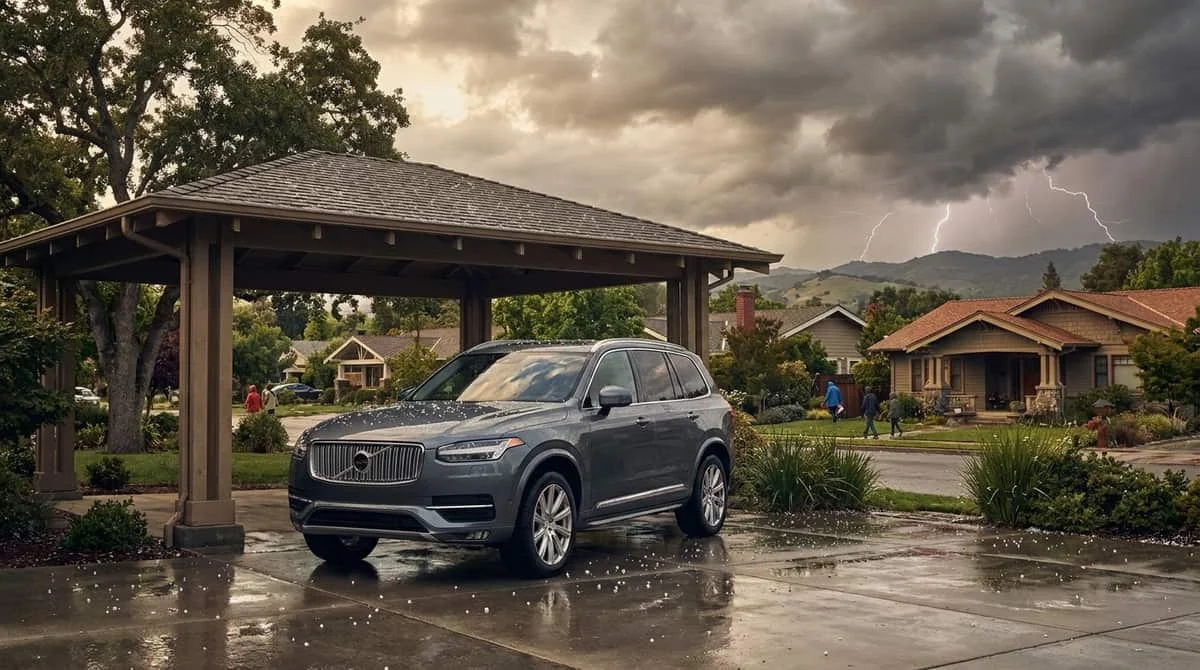
Hail can damage a vehicle in minutes. A single severe storm can leave a car covered with dents, cracked glass, chipped paint, and damage to vulnerable body panels. For Sacramento drivers, knowing how to prepare your car for hail before a storm arrives is one of the easiest ways to prevent hail damage to your car and reduce expensive repairs.
The good news is that effective car hail protection does not have to be complicated. Parking inside a garage, monitoring severe-weather alerts, using appropriate vehicle protection, and knowing what to do before and after a storm can significantly reduce your risk.
If hail does damage your vehicle, prompt inspection is important. Many hail dents can be repaired with Paintless Dent Repair (PDR) when the paint remains intact, allowing the original finish to be preserved without conventional bodywork and repainting.

Does Sacramento Get Hail?
Yes. Hail storms in Sacramento are possible, particularly when strong thunderstorms develop. Although Sacramento is not associated with hail as frequently as some areas of the central United States, severe thunderstorms can still produce hail large enough to damage vehicles.
During Sacramento hail season, weather conditions can change quickly. Thunderstorms, strong winds, heavy rain, lightning, and hail may occur together, creating several potential hazards for vehicles.
Because hail is difficult to predict at the exact location of your vehicle, preparation matters.
The goal of hail damage prevention for cars is not to assume every storm will produce damaging hail. It is to have a plan before severe weather arrives.
How to Prepare Your Car for Hail Season
The best way to prepare your car for hail season is to combine weather awareness, secure parking, physical protection, and insurance preparedness.
Here is a practical car hail protection checklist:
- Identify a covered parking location.
- Monitor local severe-weather alerts.
- Move your vehicle before the storm arrives.
- Use a properly fitted hail protection cover when appropriate.
- Avoid parking under trees or unstable structures.
- Check your auto insurance coverage and deductible.
- Keep vehicle documentation and photographs available.
- Know how to inspect your car after a hailstorm.
- Have a reputable hail damage repair provider in mind.
- Act quickly if hail damage occurs.
Planning these steps ahead of time is much easier than trying to protect a vehicle while hail is already falling.
1. Park Your Car in a Garage Whenever Possible
The most effective form of vehicle hail protection is simple: put the vehicle under a solid roof.
If severe weather is forecast, move your car into:
- A residential garage
- A secure covered parking structure
- A commercial parking garage
- Another enclosed structure designed for vehicle parking
A garage provides substantially more protection than relying on a car cover alone.
If you do not have access to a garage, consider identifying nearby covered parking before storm season. The important part is to move the vehicle before the storm begins.
Expert tip
Do not wait until you see hail outside. By that point, driving conditions may already be dangerous. Prepare your vehicle for a hailstorm before severe weather reaches your area.
2. Monitor Sacramento Severe-Weather Alerts
One of the simplest ways to protect your car from hail is to know when a storm is approaching.
During periods of increased thunderstorm activity, monitor:
- National Weather Service alerts
- Local weather forecasts
- Severe thunderstorm warnings
- Radar information
- Emergency notifications on your phone
If a severe thunderstorm warning indicates a possibility of damaging hail, treat it as a signal to move your vehicle if you can do so safely.
Weather awareness is an important part of hailstorm preparation because prevention usually has to happen before the first hailstone falls.
3. Use a Hail Protection Cover Carefully
A purpose-built hail protection cover can provide another layer of hail protection for cars when indoor parking is unavailable.
Not every ordinary car cover is designed to protect against hail. A thin fabric cover may protect against dust, sun, or light debris but provide little meaningful protection from large hailstones.
When selecting automotive hail protection, look for a product specifically designed for hail impact and make sure it fits your vehicle correctly.
However, a hail cover should not replace safe covered parking when covered parking is available.
What makes a useful hail cover?
Look for:
- Impact-absorbing padding
- Proper vehicle fit
- Secure attachment points
- Coverage of major horizontal panels
- Materials designed for severe-weather protection
Avoid improvising with heavy objects, loose blankets, mattresses, or unsecured materials. They can shift during strong winds and potentially cause additional damage.

4. Avoid Parking Under Trees
A tree may appear to provide protection from hail, but it can introduce another serious risk during severe weather.
Strong thunderstorms can produce high winds that break branches or bring down entire trees. Falling branches can cause dents, scratches, broken glass, and structural vehicle damage.
For that reason, protecting your vehicle from hail damage should include protecting it from storm-related debris.
When severe weather is approaching, choose a secure covered location rather than parking beneath a large tree.
5. Know Which Parts of a Car Are Most Vulnerable to Hail
Hail does not strike every part of a vehicle equally.
The most commonly affected areas include:
- Hood
- Roof
- Trunk lid
- Upper portions of doors
- Fenders
- Quarter panels
- Side mirrors
- Windshield and other glass
Large horizontal metal panels are particularly vulnerable because they present a broad surface directly to falling hail.
The severity of Sacramento hail damage depends on several factors, including hailstone size, wind speed, impact angle, vehicle construction, panel material, and the number of impacts.
6. Understand Aluminum and Modern Vehicle Body Panels
Modern vehicles may use a combination of steel, aluminum, plastics, composites, and other materials.
That matters when repairing hail damage.
Aluminum body panels can often be repaired, but their characteristics differ from conventional steel. Aluminum has different properties and requires appropriate tools, techniques, and technician experience.
A professional hail damage assessment should consider:
- Panel material
- Dent size
- Dent depth
- Location
- Access to the backside of the panel
- Paint condition
- Previous repairs
- Structural damage
This is one reason a quick visual estimate does not always tell the complete story.
7. Check Your Comprehensive Auto Insurance Before Storm Season
Insurance preparation is another important part of car preparation for severe weather.
In California, comprehensive coverage generally protects against damage caused by events other than collisions, including hazards such as windstorm, falling objects, and other covered losses. Your specific policy, exclusions, limits, and deductible determine what is actually covered.
Before hail season, review your declarations page and check:
- Whether comprehensive coverage is active
- Your comprehensive deductible
- Coverage limits
- Rental-car or transportation coverage
- Claim procedures
- Any relevant exclusions
California’s Department of Insurance recommends checking your policy and deductible and documenting storm damage when filing a claim.
Does comprehensive insurance cover hail damage?
Usually, hail damage is handled under comprehensive or “other than collision” coverage, but the exact terms depend on your policy.
Do not assume that every policy provides identical coverage. Confirm the details directly with your insurer.
8. Photograph Your Vehicle Before Hail Season
Taking clear photographs of your vehicle before severe weather can make it easier to document its condition if damage occurs later.
Take photos of:
- Front
- Rear
- Both sides
- Roof
- Hood
- Wheels
- Existing dents or scratches
Keep the images with your vehicle records.
If you later file an insurance claim for hail damage in Sacramento, CA, having dated documentation of the vehicle’s pre-storm condition can be useful.

9. What to Do Before a Hailstorm
If a hailstorm is approaching, your priorities should be straightforward.
Hailstorm preparation checklist
Before the storm:
- Check the latest weather alerts.
- Move the vehicle into enclosed or covered parking.
- If covered parking is unavailable, use a properly designed hail protection cover.
- Close all windows and the sunroof.
- Park away from trees and unstable structures.
- Secure loose items around your parking area.
- Avoid unnecessary driving during severe weather.
- Keep your insurance information accessible.
The safest strategy is to protect your car during a hailstorm without putting yourself at unnecessary risk.
Never put yourself in danger trying to move a vehicle after hail has already started falling.
10. What If You Cannot Prevent Hail Damage?
Even excellent hail damage prevention cannot guarantee that a vehicle will remain damage-free.
If your car is caught in a severe hailstorm, inspect it after the weather has passed and conditions are safe.
Look for:
- Small circular dents
- Large or deep dents
- Creases
- Paint chips
- Cracked or broken glass
- Damaged lights
- Damaged trim
- Loose exterior components
- Water entering through damaged seals or glass
Hail dents can sometimes be difficult to see under direct sunlight. Looking at the vehicle from different angles or using reflected light can reveal shallow dents that are otherwise easy to miss.
Hail Damage vs. PDR: When Can Paintless Dent Repair Help?
One of the most important questions after a hailstorm is whether the vehicle requires conventional body repair or Paintless Dent Repair.
PDR is particularly useful for dents where:
- The original paint remains intact.
- The metal has not been excessively stretched.
- The panel can be accessed or appropriately manipulated.
- There is no major structural damage.
With PDR, a trained technician carefully massages the damaged metal back toward its original shape using specialized tools.
Why PDR is often preferred for hail damage
| Paintless Dent Repair | Conventional Body Repair |
| Preserves intact factory paint | May involve sanding and repainting |
| No body filler for suitable dents | May require filler |
| Maintains OEM finish when successful | Paint matching may be necessary |
| Often faster for suitable hail dents | Can require multiple repair stages |
| Useful for widespread minor-to-moderate hail dents | Better suited to severe or paint-damaged damage |
PDR is not appropriate for every damaged panel. Severe dents, torn metal, damaged paint, inaccessible areas, or structural problems may require another repair approach.
A professional inspection determines the appropriate method.
Can You Prevent All Hail Damage to a Car?
No. There is no guaranteed way to prevent hail damage to a car when the vehicle is exposed to sufficiently severe hail.
The objective is to minimize hail damage, not promise zero risk.
The most effective strategy combines:
- Covered parking
- Weather monitoring
- Proper vehicle protection
- Smart parking decisions
- Insurance preparation
- Prompt post-storm inspection
These measures can significantly improve your ability to protect your vehicle from hail.
Common Mistakes That Increase Hail Damage Risk
Waiting until hail starts falling
Moving a vehicle during a severe storm can expose you to dangerous driving conditions and falling debris.
Using a regular car cover
A basic cover is not necessarily designed for hail impact.
Parking beneath trees
Branches and debris can create additional damage.
Ignoring small dents
Minor dents may seem purely cosmetic, but damaged paint or exposed metal can create additional concerns. Early inspection helps determine whether repair is necessary.
Assuming every dent requires repainting
Many suitable hail dents can be repaired using PDR without repainting. An inspection should come before deciding on conventional bodywork.
Filing an insurance claim without documenting the damage
Take photographs and keep repair estimates, invoices, and relevant communications. California’s Department of Insurance specifically recommends documenting damage and repair-related costs after covered storm losses.

How Much Does Hail Damage Repair Cost?
There is no single price for Sacramento hail damage repair.
Repair cost depends on:
- Number of dents
- Dent size
- Dent depth
- Panel location
- Vehicle make and model
- Aluminum versus steel panels
- Paint damage
- Glass damage
- Access behind the panel
- Required repair method
- Total severity of the storm damage
A vehicle with a few small dents may require substantially less work than one with hundreds of impacts across the roof, hood, trunk, and side panels.
Insurance may also affect your out-of-pocket expense. If comprehensive coverage applies, the deductible and policy terms are important considerations. California’s Department of Insurance notes that physical-damage claims generally involve the lesser of the necessary repair cost or the vehicle’s actual cash value, subject to the policy.
Does Hail Damage Affect Vehicle Value?
It can.
Unrepaired hail dents can negatively affect a vehicle’s appearance and may influence buyer perception during resale or trade-in. More extensive damage can also raise questions about the vehicle’s repair history.
Repairing appropriate hail damage can help restore the vehicle’s appearance and maintain its condition.
For newer vehicles, preserving the original factory finish through appropriate PDR can be particularly valuable when the damage qualifies for that repair method.
Expert Tips for Sacramento Drivers
If you want practical hail protection for your car, focus on preparation rather than expensive last-minute solutions.
Expert tips:
- Keep your vehicle’s garage space available during severe-weather forecasts.
- Check weather alerts before leaving your car outside for extended periods.
- Know where the nearest secure covered parking is.
- Photograph your vehicle before storm season.
- Review your comprehensive deductible before you need it.
- Do not attempt DIY dent pulling on hail damage before professional assessment.
- Have significant hail damage inspected promptly.
- Ask whether PDR is appropriate before authorizing conventional body repair.
- Keep insurance and vehicle records organized.
Hail Protection for Cars: Quick Reference
Best protection: Enclosed garage or secure covered parking.
Second-best option: Purpose-built hail protection designed for the vehicle.
Avoid: Parking beneath trees, driving unnecessarily during severe storms, or relying on thin generic car covers.
After a storm: Inspect the vehicle, photograph damage, review insurance coverage, and obtain a professional repair assessment.
For suitable dents: Ask whether Paintless Dent Repair can restore the panels while preserving the original paint.
Final Thoughts: Prepare Your Car Before Sacramento Hail Arrives
The best time to prepare your car for hail season is before the forecast shows hail directly over your neighborhood.
For Sacramento drivers, effective car hail protection starts with simple decisions: monitor severe-weather alerts, use covered parking whenever possible, avoid trees and unstable structures, understand your comprehensive insurance coverage, and know what to do if damage occurs.
If a storm does leave your vehicle with dents, do not automatically assume that repainting or replacing panels is necessary. Many hail-damaged panels can be restored with professional Paintless Dent Repair when the paint and metal remain suitable for PDR.

If your vehicle has already suffered hail damage in Sacramento, CA, Admire PDR can assess the damage and determine whether PDR is an appropriate repair solution. A professional evaluation can help you understand the condition of your panels, the available repair options, and the best path toward restoring your vehicle’s appearance.
Don’t wait for small hail dents to become an overlooked problem. Have your vehicle inspected and find out whether professional PDR can restore it while preserving the factory finish.
Frequently Asked Questions About Preparing Your Car for Hail Season
The best way to protect your car from hail is to park it inside a garage or secure covered structure before the storm arrives. If covered parking is unavailable, a purpose-built hail protection cover can provide an additional layer of protection.
Enclosed or covered parking is generally the most reliable form of hail protection for cars. A properly fitted impact-resistant hail cover can be useful when indoor parking is unavailable.
Sacramento can experience hail-producing thunderstorms when atmospheric conditions support strong convection. Because damaging hail can occur with severe thunderstorms, drivers should monitor local weather alerts rather than relying on a single fixed “hail season.”
You cannot guarantee complete hail damage prevention, but you can reduce the risk by moving your vehicle indoors, monitoring severe-weather alerts, avoiding trees, and using appropriate hail protection when covered parking is unavailable.
Hail damage is generally associated with comprehensive, or “other than collision,” coverage, but coverage depends on the specific policy and deductible. Check your declarations page and confirm coverage with your insurer.
Yes. Many hail dents can be repaired with Paintless Dent Repair when the original paint is intact and the metal has not been excessively damaged or stretched. A technician should inspect the vehicle to determine whether PDR is appropriate.
A professional inspection is worthwhile even when dents appear minor. Small hail dents may affect appearance and vehicle value, and early assessment can determine whether PDR can restore the panel efficiently while preserving the original finish.
You might also find our article intriguing:
- Headlight Restoration: Why Yellowed Headlights Are a Safety Issue, Not Just Cosmetic
- Wheel Repair: When to Save the Wheel vs Buy a New One
- Bumper Damage: PDR, Repair, or Replacement?
Good Luck to You 🌊

