
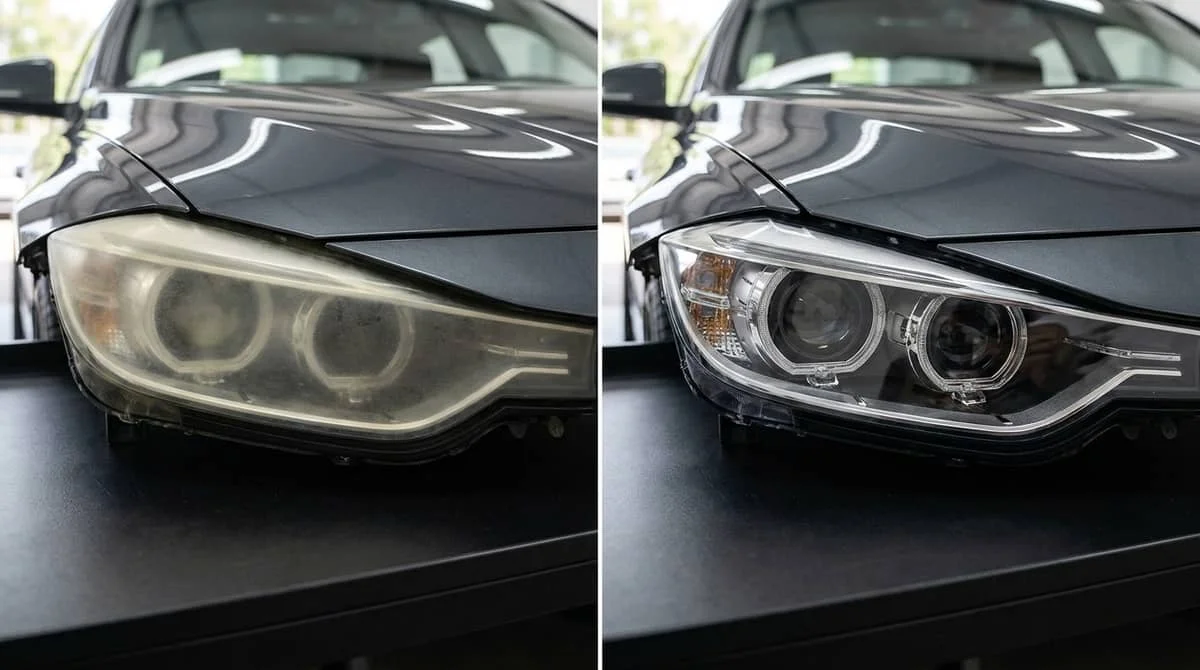
If your vehicle has yellowed headlights, cloudy headlights, hazy headlights, or faded headlight lenses, the problem is more than appearance. Over time, UV exposure, oxidation, weather, road debris, and environmental contaminants can degrade the outer surface of plastic headlight lenses. The resulting haze can reduce the amount of usable light reaching the road and make nighttime driving more difficult.
That is why headlight restoration is not simply a cosmetic detailing service. A professional headlight restoration service can remove oxidation and surface deterioration, restore lens clarity, and help preserve the appearance and performance of your headlights.
If your headlights look yellow, foggy, dull, or blurry, the right solution may be headlight lens restoration rather than immediately buying replacement headlights. However, restoration is not appropriate for every damaged lens.
This guide explains why headlights turn yellow, how UV damage affects plastic lenses, when to restore headlights, when replacement may be necessary, what professional restoration involves, and why clear headlights matter for nighttime visibility and vehicle safety.

Why Do Headlights Turn Yellow?
Modern headlights commonly use polycarbonate plastic lenses rather than traditional glass. Polycarbonate is lightweight, impact-resistant, and practical for modern vehicle design, but its exposed surface can deteriorate over time.
The factory protective coating helps protect the plastic from environmental exposure. As that protection breaks down, the lens can develop UV damage, oxidation, haze, and discoloration.
The most common causes of yellow headlights include:
- Ultraviolet (UV) exposure from sunlight
- Breakdown of the factory UV-resistant coating
- Plastic oxidation
- Road debris
- Dirt and environmental contaminants
- Extreme weather exposure
- Chemical contamination
- Age-related surface degradation
- Improper cleaning or polishing
The result can range from mild headlight lens haze to severe yellowing and cloudiness.
Featured Snippet: Why are headlights turning yellow?
Headlights turn yellow primarily because UV radiation degrades the protective surface of plastic lenses over time. Oxidation, weather exposure, road contaminants, and deterioration of the outer coating can make the lens yellow, cloudy, hazy, or faded.
Yellowed Headlights Are a Visibility Problem
A common mistake is treating yellow headlight lenses as nothing more than an appearance issue.
Headlight lenses are designed to transmit and distribute light from the headlight assembly onto the road. When the outer surface becomes heavily oxidized or hazy, light transmission and beam clarity can be affected.
This matters most when driving:
- At night
- In rain
- In fog
- On poorly lit roads
- On rural roads
- At highway speeds
- In areas with pedestrians or cyclists
A vehicle with dull headlights may still have functioning bulbs, but the lens condition can reduce the effectiveness of the lighting system.
Why this matters
Your headlights serve two jobs:
- Help you see the road and hazards.
- Help other road users see your vehicle.
That makes clear, properly functioning headlights an important part of overall vehicle safety.
What Happens When Headlight Lenses Oxidize?
Headlight oxidation occurs when the exposed plastic surface deteriorates through environmental and UV exposure.
You may notice:
- Yellow oxidation on headlights
- White or milky haze
- Cloudy plastic headlights
- Faded headlight lenses
- A rough or chalky surface
- Foggy-looking covers
- Reduced visual clarity
- Uneven discoloration
In advanced cases, the lens may appear almost opaque.
The appearance can vary depending on the vehicle, climate, age of the headlight, previous repairs, and condition of the protective coating.
Headlight Oxidation vs Internal Moisture
Not every cloudy headlight is caused by oxidation.
This distinction is important.
Exterior oxidation
If the haze is primarily on the outside surface, headlight restoration may be an appropriate solution.
Internal condensation
Moisture inside the headlight assembly can indicate:
- Damaged seals
- Cracked housing
- Ventilation issues
- Water intrusion
In that situation, polishing the exterior won’t solve the underlying problem.
Internal damage
Restoration may also be inappropriate if the assembly has:
- Severe internal discoloration
- Burned components
- Damaged reflectors
- Cracked housing
- Internal lens damage
A professional inspection should determine whether the problem is surface oxidation or something deeper.
What Is Headlight Restoration?
Headlight restoration is the process of removing deteriorated material and oxidation from the exterior surface of a plastic headlight lens and then applying an appropriate protective finish.
A professional restoration may involve several stages depending on the condition of the lens.
Typical process
- Inspect the headlight.
- Protect surrounding paint and trim.
- Remove surface contamination.
- Level deteriorated material using appropriate abrasives.
- Refine the surface through progressively finer steps.
- Polish the lens to restore optical clarity.
- Apply UV-resistant protection.
- Inspect the finished lens.
The exact process varies according to lens condition and the restoration system being used.

Does Headlight Restoration Really Work?
Yes, professional headlight restoration can significantly improve the appearance and clarity of many oxidized plastic lenses.
The key is understanding what restoration can and cannot correct.
Restoration is most effective when:
- Oxidation is primarily on the exterior.
- The plastic remains structurally intact.
- The lens is cloudy or yellow from surface degradation.
- There are no major cracks.
- Internal components are still functional.
- The lens has sufficient material remaining for controlled restoration.
Restoration cannot reverse every form of headlight damage.
A badly cracked lens, severe internal deterioration, or damaged headlight housing may require replacement.
Headlight Restoration vs Headlight Replacement
One of the most important decisions is whether to restore headlights or replace the entire assembly.
| Factor | Headlight Restoration | Headlight Replacement |
| Surface oxidation | Excellent candidate | Usually unnecessary |
| Yellowing | Often effective | Possible but expensive |
| Exterior haze | Often effective | Not always necessary |
| Minor surface scratches | May improve | Usually unnecessary |
| Cracked lens | Limited | Often appropriate |
| Internal damage | Does not correct it | May be required |
| Damaged housing | Does not correct it | Often required |
| Cost | Usually lower | Usually higher |
| Original assembly retained | Yes | No |
If the primary problem is plastic headlight oxidation, restoration may be a more economical solution than replacing a functional headlight assembly.
When Should You Restore Your Headlights?
Consider headlight lens restoration when you notice:
- Yellow headlights
- Cloudy headlights
- Hazy headlights
- Foggy headlights
- Faded headlights
- Dull lenses
- Yellow plastic headlights
- Surface oxidation
- Reduced optical clarity
You should also consider restoration when the lenses are visibly deteriorated but the underlying headlight assemblies remain functional.
A simple visual test
Stand several feet in front of the vehicle in daylight and compare the two headlights.
Look for:
- Yellowing
- White haze
- Uneven clarity
- Surface roughness
- Heavy discoloration
- Visible oxidation
Then inspect the lenses under nighttime lighting conditions.
If the lenses are significantly hazy, professional assessment is worthwhile.
How UV Damage Affects Headlights
UV damage to headlights is one of the primary reasons plastic lenses deteriorate.
Sunlight contains ultraviolet radiation that can break down the surface of exposed plastics. Vehicles that spend substantial time outdoors are continuously exposed to this process.
Over years, the protective surface can deteriorate.
This creates a cycle:
UV exposure → protective coating degradation → plastic oxidation → yellowing/haze → reduced lens clarity
That is why simply washing the vehicle does not prevent UV damaged headlight lenses from developing.
Why a UV-Resistant Coating Matters After Restoration
Removing oxidation is only part of the job.
If the newly restored surface isn’t adequately protected, the lens can begin deteriorating again.
A quality restoration system should therefore include appropriate protection designed for automotive headlight lenses.
Depending on the service, protection may involve a:
- UV-resistant coating
- Headlight-specific protective coating
- Sealant
- Professional-grade surface protection
The goal is to slow future oxidation and extend the useful life of the restoration.
Expert Tip
If you’re comparing headlight restoration services, don’t ask only, “Will you polish my headlights?”
Ask what happens after polishing.
A restoration process that removes oxidation but provides inadequate protection may not deliver the long-term result you expect.

Can You Polish Yellowed Headlights?
Lightly oxidized headlights may improve with polishing, but severe oxidation generally requires more than simply buffing the surface.
Polishing can help with:
- Light haze
- Minor surface imperfections
- Fine scratches
- Residual oxidation after proper surface preparation
More severe oxidation may require:
- Controlled sanding
- Multiple abrasive stages
- Progressive refinement
- Machine polishing
- UV-resistant protection
Simply applying polish to heavily oxidized plastic may produce a temporary improvement without properly removing the degraded surface.
Why DIY Headlight Restoration Sometimes Fails
DIY headlight restoration kits can produce good results when used correctly, but the process is easy to underestimate.
Common problems include:
1. Incomplete oxidation removal
The surface may look better temporarily while deteriorated material remains.
2. Uneven sanding
Improper technique can leave visible sanding marks or inconsistent clarity.
3. Insufficient refinement
If the surface isn’t progressively refined, the lens may remain cloudy.
4. Poor masking
Aggressive abrasives or compounds can damage surrounding paint and trim.
5. No durable UV protection
The headlights can yellow again relatively quickly if the restored plastic is left inadequately protected.
6. Over-aggressive sanding
Removing excessive material unnecessarily can create additional problems.
Professional restoration relies on controlled surface correction rather than simply sanding until the lens appears clear.
Are Cloudy Headlights Dangerous?
Severely cloudy headlights can be a safety concern because they may interfere with optimal light transmission and beam performance.
The actual effect depends on the severity and condition of the lens and lighting system.
You should pay particular attention if you notice:
- Reduced nighttime visibility
- Headlights that appear dim
- Uneven light distribution
- Difficulty seeing road hazards
- Significant haze across the lens
- Yellow or brown discoloration
- Major surface deterioration
Headlight restoration doesn’t replace a proper lighting-system inspection, but restoring severely oxidized lenses can be an important part of maintaining vehicle visibility.
Headlight Restoration and Vehicle Appearance
Safety should be the primary reason to address degraded headlights, but appearance matters too.
Yellow, faded, and discolored headlights can make an otherwise well-maintained vehicle look significantly older.
Restored lenses can improve:
- Front-end appearance
- Vehicle presentation
- Exterior condition
- Perceived maintenance quality
This can be particularly useful before:
- Selling a vehicle
- Trading in a vehicle
- Returning a lease
- Photographing a vehicle for sale
- Completing other exterior repairs
Headlight restoration can complement other cosmetic services such as paint correction, scratch repair, dent removal, and exterior detailing.
Does Headlight Restoration Increase Vehicle Value?
It is unlikely that headlight restoration alone will dramatically increase a vehicle’s market value.
However, it can improve the vehicle’s overall presentation.
That matters because buyers often evaluate a vehicle based on its visible condition.
Freshly restored headlights can help eliminate an obvious sign of neglect and make the vehicle look better maintained.
For a relatively small exterior improvement, the visual impact can be substantial.

Headlight Restoration After Collision Damage
Headlights can also become damaged during collisions.
A collision may cause:
- Cracked lenses
- Broken mounting points
- Damaged housings
- Misaligned headlights
- Internal component damage
- Surface scratches
- Paint transfer
This is different from normal oxidation.
If the vehicle has been involved in a collision, a professional should determine whether the headlight assembly remains structurally and functionally sound.
Restoration is appropriate for surface deterioration—not as a substitute for replacing a damaged safety component.
How Headlight Condition Relates to Other Vehicle Repairs
Headlight condition is one part of overall exterior vehicle maintenance.
A vehicle may simultaneously have:
- Hail dents
- Door dings
- Minor collision damage
- Scratched paint
- Wheel damage
- Oxidized headlights
A professional automotive repair provider can help determine which issues require cosmetic restoration and which require functional repair or replacement.
For example, PDR may be appropriate for a suitable dent while headlight restoration addresses UV-damaged plastic separately.
The repair method should always match the material and type of damage.
Pros and Cons of Professional Headlight Restoration
Pros
- Restores lens clarity
- Improves exterior appearance
- Can improve usable light transmission when oxidation is the limiting factor
- Usually costs less than complete assembly replacement
- Retains the original headlight assembly
- Addresses surface UV oxidation
- Can extend the useful appearance of existing headlights
Cons
- Not suitable for every damaged headlight
- Severe internal damage may still require replacement
- Cracked housings cannot be fixed through surface polishing
- Results depend on lens condition and restoration quality
- Future UV exposure can eventually cause additional deterioration
Common Headlight Restoration Mistakes
Avoid these mistakes when trying to restore oxidized headlights:
- Using household cleaners or abrasive chemicals not designed for automotive plastics.
- Skipping surface preparation.
- Using one aggressive abrasive instead of progressive refinement.
- Failing to protect the surrounding paint.
- Polishing without addressing severe oxidation.
- Ignoring internal condensation.
- Skipping UV protection after restoration.
- Assuming every cloudy lens can be restored.
- Ignoring reduced nighttime visibility.
- Replacing the entire assembly when only exterior oxidation is present.
Expert Tips for Preventing Yellow Headlights
You can’t eliminate UV exposure completely, but you can slow the deterioration process.
1. Park in a garage when possible
Reducing direct sunlight exposure can help preserve exterior plastics.
2. Use appropriate automotive protection
A quality UV-resistant protective product can help reduce future surface degradation.
3. Keep headlights clean
Road film and environmental contaminants can make existing haze more noticeable.
4. Don’t wait until the lenses are opaque
Early surface deterioration is generally easier to address than severe oxidation.
5. Inspect headlights regularly
Include headlights in your normal vehicle walk-around.
6. Address damage promptly
Cracks or impact damage should be evaluated before water enters the assembly.

How Much Does Headlight Restoration Cost?
The cost of a headlight restoration service depends on several factors:
- Vehicle type
- Number of headlights
- Severity of oxidation
- Lens condition
- Required surface preparation
- Restoration method
- Protective coating
- Local labor rates
Professional restoration is typically less expensive than replacing an entire headlight assembly, but pricing varies by vehicle and service provider.
For an accurate estimate, the headlights should be inspected rather than quoting solely from a description such as “yellow headlights.”
Headlight Restoration Near Me: What to Look For
If you’re searching for headlight restoration near me, don’t choose a provider based solely on the lowest advertised price.
Look for a professional who:
- Inspects the lens before starting
- Explains whether restoration is appropriate
- Uses a controlled surface-restoration process
- Protects surrounding body panels
- Applies appropriate UV protection
- Understands the difference between surface oxidation and internal damage
- Shows examples of completed work
- Doesn’t promise that every headlight can be restored
For vehicle owners in the Sacramento area, Admire PDR can evaluate exterior vehicle damage and determine whether headlight restoration is an appropriate part of the repair process.
Headlight Restoration vs DIY: Which Is Better?
| Consideration | DIY | Professional Service |
| Initial cost | Lower | Higher |
| Equipment | Limited | Professional equipment |
| Surface preparation | Depends on skill | Controlled |
| Finish consistency | Variable | More predictable |
| UV protection | Product-dependent | Professional system |
| Risk of sanding errors | Higher | Lower |
| Severe oxidation | More difficult | Better suited |
| Internal damage diagnosis | Limited | Professional assessment |
DIY restoration can be reasonable for mild oxidation if the owner understands the process.
For heavily oxidized headlights, inconsistent results, or expensive vehicles where appearance matters, professional restoration may be the better choice.
When Headlight Restoration Is Not Enough
Headlight restoration isn’t a universal fix.
Replacement or additional repair may be necessary when you have:
- Cracked headlight housing
- Broken mounting tabs
- Severe internal moisture
- Internal reflector damage
- Internal lens damage
- Burned lighting components
- Severe impact damage
- Permanent discoloration inside the assembly
If the light itself isn’t functioning correctly, polishing the outside won’t solve the problem.
A technician should distinguish between surface oxidation and a defective headlight assembly.
A Simple Headlight Inspection Checklist
Before scheduling service, check:
- Are the lenses yellow?
- Is there visible UV oxidation?
- Are the headlights cloudy or hazy?
- Is the haze on the outside?
- Are there deep scratches?
- Is the lens cracked?
- Is there moisture inside?
- Are the headlights equally clear?
- Has nighttime visibility decreased?
- Does the vehicle need other exterior repairs?
If most of the problem is exterior yellowing or haze, headlight restoration may be an effective solution.

Summary: Why Yellowed Headlights Shouldn’t Be Ignored
Yellowed headlights are more than a cosmetic problem. UV exposure and oxidation can degrade plastic headlight lenses, creating yellow, cloudy, hazy, or faded surfaces that may interfere with optimal lighting performance and nighttime visibility.
A professional headlight restoration service can often restore heavily oxidized exterior lenses without replacing an otherwise functional headlight assembly.
The key is identifying the type of damage.
Restore headlights when the problem is primarily exterior oxidation, haze, or surface deterioration. Consider replacement when the assembly has cracks, internal damage, broken mounting points, severe moisture intrusion, or other problems that surface restoration cannot correct.
If you’re seeing yellow headlights, cloudy headlights, oxidized headlights, or faded headlight lenses, don’t wait until visibility becomes a bigger concern.
A professional inspection can determine whether your vehicle needs headlight lens restoration, additional repair, or complete headlight replacement.
For vehicle owners in Sacramento, Admire PDR can help evaluate exterior vehicle condition and recommend the appropriate repair approach rather than treating every problem as a replacement job.
Get Your Headlights Evaluated
Clear headlights improve the appearance of your vehicle and can contribute to better nighttime visibility. If your lenses have developed significant headlight oxidation, UV damage, yellowing, haze, or discoloration, have them evaluated by a professional.
The right restoration process can remove deteriorated surface material, improve lens clarity, and protect the restored surface for longer-lasting results.
Frequently Asked Questions
Headlights turn yellow primarily because ultraviolet radiation and environmental exposure degrade the protective surface of plastic lenses. As the surface deteriorates, oxidation develops and the lens can become yellow, cloudy, hazy, or faded.
Yes. Many yellowed headlights can be restored when the oxidation and haze are primarily on the exterior surface. Professional headlight restoration removes the deteriorated surface and refines the lens before applying appropriate protection.
Severely cloudy or oxidized headlights can affect optical clarity and potentially reduce the effectiveness of the vehicle’s lighting. If nighttime visibility has decreased or the lenses are heavily hazy, professional inspection and restoration should be considered.
Professional restoration generally involves cleaning and preparing the lens, removing oxidized material through controlled abrasion, progressively refining the surface, polishing it, and applying UV-resistant protection.
When the problem is exterior oxidation, restoration can be a cost-effective alternative to replacing an otherwise functional headlight assembly. Replacement may be necessary for cracked housings, severe internal damage, broken mounting points, or significant water intrusion.
The lifespan depends on the vehicle’s exposure to sunlight, climate, cleaning practices, and the protective coating used after restoration. A properly prepared and UV-protected lens generally lasts longer than one that is simply polished without durable protection.
DIY headlight restoration can work for mild to moderate oxidation when the process is performed correctly. However, aggressive sanding, inadequate surface refinement, poor masking, or insufficient UV protection can produce poor results. Professional restoration is preferable when oxidation is severe or consistent results are important.
You might also find our article intriguing:
- Wheel Repair: When to Save the Wheel vs Buy a New One
- Bumper Damage: PDR, Repair, or Replacement?
- Preparing Your Car for Hail Season in Sacramento
Good Luck to You 🌊

