
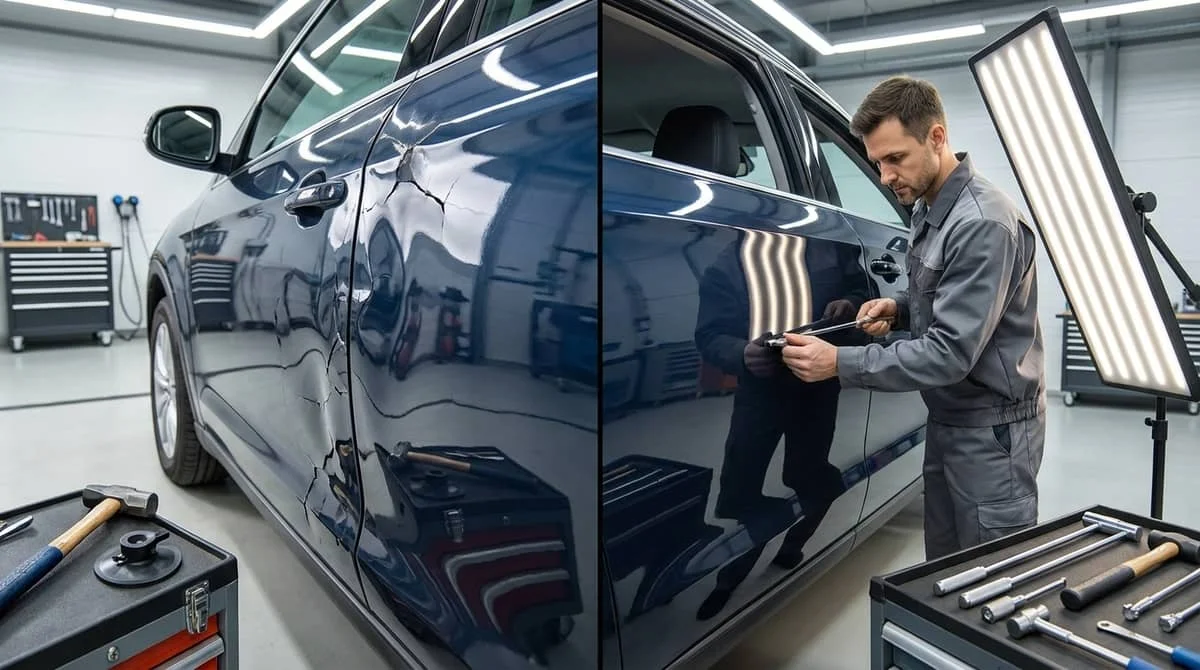
Sometimes—but only in very limited situations. While online videos often make dent removal look easy, the reality is very different. Most DIY dent repair fails occur because vehicle owners don’t understand how automotive sheet metal behaves after an impact. Without professional tools, specialized lighting, and years of experience, it’s easy to make a dent worse instead of better.
Many DIY dent repair kits can temporarily improve the appearance of a shallow dent, but they rarely restore the panel to factory condition. In many cases, improper repairs create new problems such as stretched metal, high spots, cracked paint, or distorted body lines that are more expensive to fix later.
If you’re wondering does DIY dent repair work, this guide explains why professional Paintless Dent Repair (PDR) consistently delivers better results and why at-home methods often fail.
Why DIY Dent Repair Often Fails
Professional Paintless Dent Repair is far more complex than simply pulling a dent outward.
Every dent changes:
- Metal tension
- Panel shape
- Reflection lines
- Paint stress
- Internal pressure
- Bodyline alignment
A professional technician carefully restores all of these elements—not just the visible dent.
DIY repairs usually focus on only one thing:
Pulling the dent outward.
Unfortunately, that’s rarely enough.

Understanding How Vehicle Metal Behaves
Modern vehicles are engineered using:
- High-strength steel
- Aluminum alloys
- Reinforced body panels
- Factory paint systems
- Structural adhesives
When a dent occurs, the metal doesn’t simply move inward.
Instead, the impact creates:
- Low spots
- High spots (crowns)
- Metal stretching
- Internal tension
- Paint stress
Professional PDR technicians spend years learning how metal “remembers” its original shape while understanding when stretching has permanently changed the panel.
This concept—often called metal memory—is one of the biggest reasons DIY repairs fail.
Common DIY Dent Repair Mistakes
1. Using the Wrong Dent Repair Kit
The internet is full of inexpensive car dent repair kits promising professional results.
Most include:
- Glue tabs
- Pull bridges
- Slide hammers
- Dent puller kits
- Plastic wedges
- Knockdown tools
The problem?
These kits cannot determine:
- Metal thickness
- Dent depth
- Paint condition
- Panel tension
- Hidden structural damage
- Previous repainting
Without understanding these variables, the repair becomes guesswork.
2. Over-Pulling the Dent
One of the biggest DIY dent repair mistakes is using excessive pulling force.
When too much force is applied:
- The dent pops too high.
- New high spots form.
- Reflection lines become distorted.
- Metal stretches.
- Additional repair becomes more difficult.
Professional technicians move metal a fraction of a millimeter at a time.
DIY users often try to fix the dent in one pull.

3. Under-Pulling the Dent
The opposite problem is also common.
Many DIY repairs improve only part of the dent.
Remaining issues include:
- Low spots
- Soft waves
- Uneven reflections
- Distorted body lines
Although the dent appears “better,” it’s still clearly visible under sunlight or LED inspection lights.
4. Ignoring Dent Crowns
Most dents create surrounding pressure areas called crowns.
If these raised areas aren’t relieved first:
- The dent resists movement.
- Pulling becomes uneven.
- Metal stretches.
- Repair quality decreases.
Professional PDR repairs involve balancing highs and lows—not simply pulling the center.
5. Working Without Professional Lighting
Perhaps the biggest difference between DIY repair and professional PDR is lighting.
Professional technicians use:
- Reflection boards
- LED PDR lights
- Precision line boards
- Optical distortion patterns
These reveal imperfections invisible under normal garage lighting.
Without them, it’s impossible to judge whether the panel has actually returned to its original contour.
Why Dent Repair Kits Don’t Work on Every Dent
Many consumers ask:
Why don’t dent repair kits work?
Because not every dent is the same.
Factors affecting repair include:
| Dent Factor | DIY Success |
| Shallow center dent | Sometimes |
| Sharp crease | Rarely |
| Bodyline dent | Poor |
| Edge dent | Very Poor |
| Aluminum panel | Very Difficult |
| Hail dents | Usually Poor |
| Repainted panel | High Risk |
| Cracked paint | Not Recommended |
The more complex the dent, the less likely DIY methods will succeed.

Problems With Popular Home Dent Repair Methods
Suction Cup Dent Repair
A suction cup dent repair tool only works on:
- Large
- Smooth
- Shallow dents
It struggles with:
- Door dings
- Sharp dents
- Creases
- Bodylines
- Small hail dents
Most parking lot dents are too small for effective suction.
Glue Pull Dent Repair Kit
Glue pulling is a legitimate professional technique.
However, professionals understand:
- Glue strength
- Tab size
- Pull direction
- Metal movement
- Paint condition
DIY users often:
- Use incorrect glue
- Pull too aggressively
- Damage aftermarket paint
- Leave high spots
Improper glue pulling frequently creates additional repair complications.
Boiling Water & Heat Gun Methods
Videos showing boiling water, hair dryers, or heat guns are among the most misleading DIY repair trends.
Excessive heat can cause:
- Paint cracking
- Clear coat damage
- Plastic deformation
- Paint discoloration
- Adhesive failure
Professional PDR occasionally uses controlled heat—but only with specialized temperature management.

DIY Dent Repair Risks
Attempting at-home dent repair can lead to:
- Stretched metal damage
- Paint cracking
- Clear coat failure
- High spots
- Low spots
- Distorted reflections
- Bodyline damage
- Broken trim
- Reduced resale value
These dent repair complications often increase professional repair costs.
When DIY Dent Repair Doesn’t Work
Professional technicians commonly see:
- Failed dent repair attempts
- Poor glue pulling
- Over-pulled metal
- Improper dent removal
- DIY paint damage
- Distorted aluminum panels
Ironically, many of these dents would have been easier—and less expensive—to repair before the DIY attempt.
Why Professionals Get Better Results
Paintless Dent Repair technicians spend years mastering:
- Metal movement
- Panel access
- Reflection reading
- Tool leverage
- Glue pulling
- Knockdown techniques
- Aluminum repair
- Hail damage repair
- Door ding repair
Professional PDR also requires thousands of dollars in specialized equipment unavailable in consumer repair kits.

DIY Dent Repair vs Professional PDR
| DIY Dent Repair | Professional Paintless Dent Repair |
| Consumer tools | Specialized professional tools |
| No reflection lighting | Precision LED lighting |
| Trial-and-error | Years of training |
| Risk of paint damage | Factory paint preserved |
| Limited success | High success rate on eligible dents |
| Can increase repair cost | Restores original panel shape |
| Best for experimentation | Best for long-term results |
When Should You Skip DIY Repair?
Avoid DIY repairs if the dent involves:
- Cracked paint
- Aluminum panels
- Sharp creases
- Hail damage
- Door edges
- Bodylines
- Previous repainting
- Collision damage
- Multiple dents
These repairs require professional evaluation.
Why Drivers Choose Admire PDR
When your vehicle has door dings, parking lot dents, hail damage, or other minor body damage, choosing an experienced Paintless Dent Repair specialist protects your factory finish and helps maintain vehicle value.
Drivers choose Admire PDR because of:
- Skilled PDR technicians
- Advanced dent repair equipment
- Expertise with steel and aluminum panels
- Professional hail damage repair
- Honest repair assessments
- Fast turnaround times
- Preservation of OEM factory paint
- High-quality customer service
Instead of risking DIY dent repair damage, a professional inspection helps determine whether Paintless Dent Repair is the safest and most cost-effective solution.

Expert Tips
✔ Don’t attempt repairs immediately after watching one online video.
✔ Photograph the dent before trying any repair.
✔ If the paint is cracked, skip DIY methods.
✔ Never use uncontrolled heat.
✔ Have aluminum dents inspected professionally.
✔ Compare repair costs before risking permanent damage.
Summary
So, why DIY dent repair often fails comes down to one simple fact:
Professional dent repair is far more complex than pulling metal outward.
Successful Paintless Dent Repair requires:
- Understanding metal behavior
- Reading reflection patterns
- Managing paint stress
- Correcting highs and lows
- Using specialized tools
- Years of practical experience
While some DIY car dent repair methods may slightly improve very shallow dents, most DIY dent removal problems arise because consumer tools cannot match professional training or equipment.
If your vehicle has a dent, the safest option is a professional evaluation. An experienced PDR technician can determine whether the dent qualifies for Paintless Dent Repair and restore your vehicle while preserving its factory finish.
Frequently Asked Questions
DIY dent repair may improve some large, shallow dents, but it rarely restores the panel to factory condition. Sharp dents, bodylines, aluminum panels, and hail damage typically require professional PDR.
Dent repair kits don’t account for metal tension, paint condition, panel design, or hidden damage. Improper use can create high spots, stretched metal, and paint damage.
Yes. Common risks include cracked paint, distorted bodylines, over-pulled metal, broken trim, and increased repair costs.
Only in limited situations involving large, shallow dents on flat panels. Most door dings and sharp dents are poor candidates.
Glue pulling requires proper technique and should not be used on unknown or previously repainted surfaces. Incorrect use may lift paint or worsen the dent.
Choose professional PDR whenever the dent affects a bodyline, aluminum panel, hail-damaged area, or has cracked paint, or when maintaining the factory finish is important.
In many cases, yes. Professional Paintless Dent Repair preserves the original paint, helps maintain resale value, and can prevent additional damage caused by unsuccessful DIY repair attempts.
You might also find our article intriguing:
- Top Mistakes People Make with Dent Repair
- Top Causes of Car Dents and How to Prevent Them
- How to Maintain Your Car After Dent Repair
Good Luck to You 🌊

