
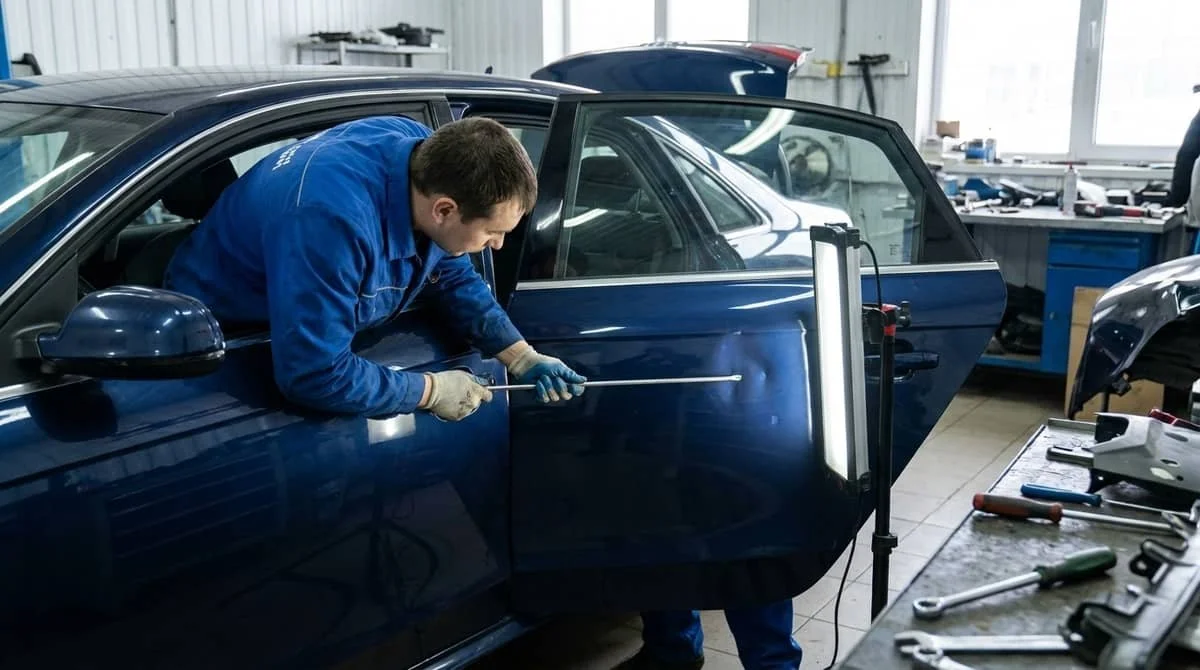
What is paintless dent repair, and why has PDR become one of the most popular vehicle restoration methods in modern auto repair? Understanding what PDR is, how paintless dent repair works, and the full meaning of PDR in auto repair helps vehicle owners choose a faster, more cost-effective solution for cosmetic dent damage. Paintless dent removal is a specialized technique that repairs dents without repainting while maintaining the original factory finish. Unlike traditional body repair, the PDR dent repair method uses advanced tools and controlled pressure to restore damaged panels through a precise paintless dent repair process.
Today, how paintless dent repair works is one of the most searched topics in cosmetic automotive repair because drivers want non-invasive dent repair, faster service, and factory paint preservation without fillers or repainting.
What Is PDR? Paintless Dent Repair Explained
PDR Meaning in Auto Repair
The term PDR, meaning in auto repair, stands for Paintless Dent Repair, also known as paintless dent removal. This repair method restores vehicle panels by carefully reshaping metal from behind the damaged area.
Paintless Dent Repair Explained
In simple terms, paintless dent repair explained means:
- Removing dents without sanding
- Repairing dents without repainting
- Preserving factory paint integrity
The entire paintless dent repair process focuses on restoring the original panel shape while avoiding conventional body filler and paint procedures.

How Paintless Dent Repair Works
Understanding how paintless dent repair works requires knowing the technical principles behind the dent massage repair method.
How does PDR work?
The process involves:
- Accessing the backside of the damaged panel
- Using specialized rods and tools
- Applying controlled pressure to reshape the metal
- Gradually restoring the panel contour
This non-invasive dent repair method allows technicians to perform factory paint preservation repair while eliminating dents.
Paintless Dent Removal Techniques
Several paintless dent removal techniques are used depending on the dent type and panel access.
Common techniques include:
- Push-to-paint correction
- Glue pulling systems
- Precision metal reshaping
- Heat-assisted dent correction
These methods are all part of the broader PDR dent repair method used in modern auto restoration.
Tools Used in PDR
The specialized tools used in PDR are designed for precision dent manipulation.
Common PDR tools:
- Metal rods
- Glue tabs
- Reflection boards
- LED dent lights
- Tap-down tools
These tools support the dent massage repair method required for accurate metal restoration without damaging paint.
Dents That Can Be Repaired with PDR
Many common vehicle dents fall into the category of dents that can be repaired with PDR.
Common PDR-compatible damage:
- Hail damage paintless dent repair
- Door ding repair without paint
- Minor dent repair PDR
- Body line dent repair
- Some creased dent PDR cases
In many situations, whether large dents can be repaired with PDR depends on metal stretching and paint condition.
Can Large Dents Be Repaired with PDR?
A frequent question is: Can large dents be repaired with PDR?
Sometimes yes, if:
- Paint remains intact
- Metal is not overstretched
- Dent edges are smooth
- Damage is accessible
However, severe impact damage may exceed the limitations of paintless dent repair.

When PDR Does Not Work
There are situations where PDR does not work, which becomes important for repair planning.
Common limitations:
- Dents too severe for PDR
- Sharp creases
- Severe metal stretching
- Structural collision damage
Paint-related limitations:
- Paint damage and PDR
- Cracked paint dent repair
- Peeling or chipped paint
In these cases, when traditional body repair is needed becomes unavoidable.
Limitations of Paintless Dent Repair
The primary limitations of paintless dent repair include:
- Deep collision dents
- Torn metal
- Severe body line distortion
- Paint cracking
Although paintless dent removal is highly effective, not all damage qualifies for repairing dents without repainting.
Benefits of Paintless Dent Repair
The major benefits of paintless dent repair explain why it continues to grow in popularity.
Advantages of PDR:
- Faster dent repair method
- Lower repair cost
- No repainting required
- Factory paint preservation and repair
- Eco-friendly dent repair
Because no chemicals or paint materials are required, eco-friendly dent repair has become a strong selling point for environmentally conscious drivers.
Why Choose Paintless Dent Repair?
Why choose paintless dent repair?
Vehicle owners choose paintless dent repair (PDR) because it:
- Maintains vehicle originality
- Helps maintain vehicle resale value
- Reduces repair downtime
- Prevents paint mismatch issues
The ability to maintain vehicle resale value is one of the strongest long-term advantages of PDR.
PDR vs Traditional Body Repair
Compared to conventional body repair:
- PDR preserves factory paint
- Traditional repair requires fillers and repainting
- PDR is a faster dent repair method
- Traditional repair takes longer and costs more
This is why paintless dent repair explained continues to dominate cosmetic dent restoration searches.
Need expert help understanding how paintless dent repair works or whether your damage qualifies for the PDR dent repair method restoration?
Contact Admire PDR today for professional evaluation and fast, high-quality paintless dent repair service.

What Is Paintless Dent Repair?
So, what is paintless dent repair? It is an advanced, non-invasive dent repair solution focused on repairing dents without repainting while preserving the factory finish. The paintless dent repair process uses specialized tools used in PDR and precision paintless dent removal techniques to restore damaged panels quickly and efficiently.
For professional evaluation of dents that can be repaired with PDR, Admire PDR provides expert assessment, cosmetic dent correction, and advanced paintless dent removal services.
FAQ: What Is Paintless Dent Repair (PDR)?
Paintless dent repair (PDR) is a non-invasive dent repair method used to remove dents without sanding, fillers, or repainting. The process restores the original shape of the metal while preserving the factory paint finish.
How paintless dent repair works involves accessing the backside of a damaged panel and using specialized tools to carefully massage the metal back into shape. This dent massage repair method allows technicians to perform dent repair without repainting.
Common dents that can be repaired with PDR include:
– Door dings
– Hail damage
– Minor dents
– Some body line dents
– Certain creased dents
The success of paintless dent removal depends on dent depth, paint condition, and metal stretching.
Yes, some large dents can be repaired with PDR if the paint is intact and the metal has not been overstretched. However, very deep or sharp dents may exceed the limitations of paintless dent repair.
No, paintless dent repair is designed for factory paint preservation. When performed correctly, the process removes dents without damaging the original paint surface.
When PDR does not work usually involves:
– Cracked or chipped paint
– Severe collision damage
– Deep, sharp dents
– Excessive metal stretching
In these cases, when traditional body repair is needed, repainting and filler repair may be required.
Yes, paintless dent removal is considered a permanent repair method. Once the metal is restored correctly, the dent does not normally return.
The main benefits of paintless dent repair include:
– Faster dent repair method
– Lower repair costs
– No repainting
– Maintain vehicle resale value
– Eco-friendly dent repair solution
These advantages of PDR make it one of the most popular cosmetic auto repair methods today.
You might also find our article intriguing:
- Can All Dents Be Repaired Without Painting?
- Mobile PDR vs Shop Repair: Speed & Results
- Paintless Dent Repair vs Traditional Body Shop: Which Is Better?
Good Luck to You 🌊

