
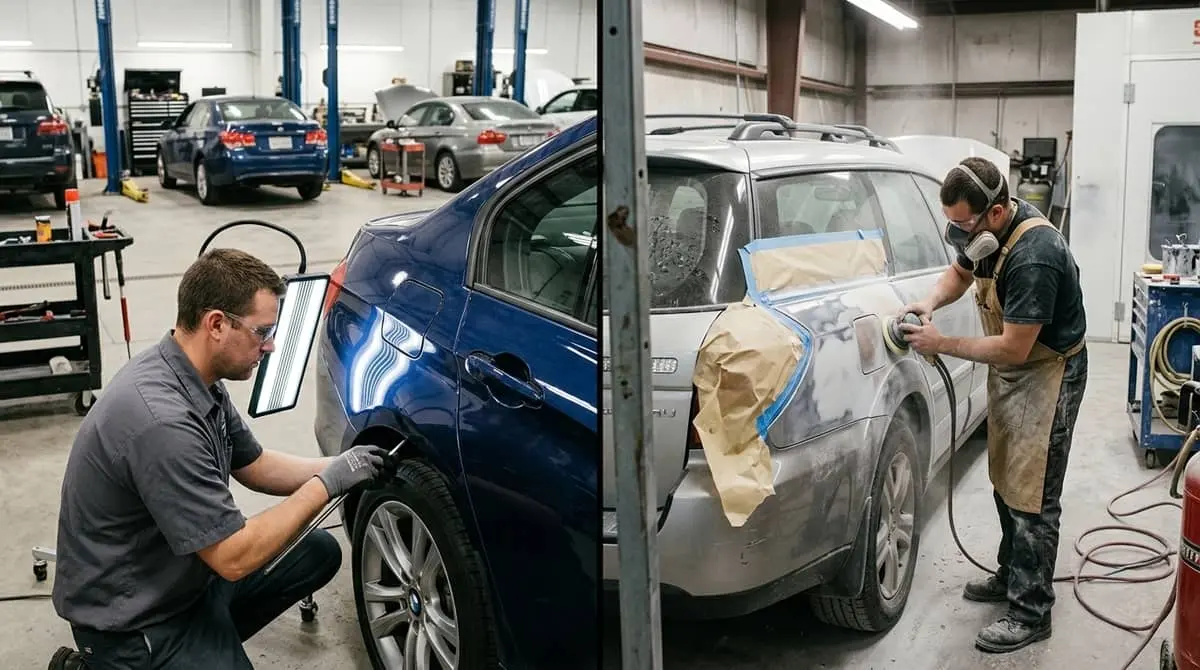
When comparing paintless dent repair vs traditional body shop, vehicle owners are usually trying to decide between speed, cost, and long-term paint integrity. The real debate around PDR vs body shop, or more broadly paintless dent repair vs auto body repair, comes down to whether the damage can be corrected without repainting or requires full structural and cosmetic restoration.
Understanding which dent repair is better depends on dent size, depth, paint condition, and whether you are dealing with door dings, hail damage, or collision damage.
What Is Paintless Dent Repair (PDR)?
Paintless dent repair (PDR) is a modern technique designed to remove dents without sanding, fillers, or repainting. The paintless dent removal process involves specialized tools that massage the metal back to its original shape.
Key Definition:
- What is paintless dent repair?
A non-invasive method of restoring vehicle panels without affecting factory paint.
Common use cases:
- PDR for door dings
- PDR for hail damage
- Minor dents with intact paint

Benefits of Paintless Dent Repair
The benefits of paintless dent repair are a major reason why it is often preferred over conventional repair methods.
Main advantages:
- Preserves factory paint (no repainting vs dent removal conflict)
- Faster turnaround time
- Lower labor cost
- Higher resale value retention
These PDR advantages make it one of the most efficient dent correction methods available today.
Is PDR worth it?
For most minor to moderate dents, is PDR worth it? — yes, especially when paint is not cracked or chipped.
Traditional Auto Body Repair Process Explained
The traditional auto body repair process is significantly more complex and involves multiple stages:
- Sanding damaged areas
- Applying body filler
- Priming and repainting
- Color matching and blending
- Curing and finishing
Body shop dent repair methods include:
- Panel replacement
- Welding or reshaping
- Full repainting
This approach is often required in severe damage cases or when structural integrity is affected.
Paintless Dent Repair vs Traditional Repair: Direct Comparison
The key comparison of paintless dent repair vs traditional repair highlights major differences in cost, time, and quality.
PDR vs conventional dent repair:
- PDR preserves original paint
- Traditional repair requires repainting
Dent repair methods comparison:
| Factor | Paintless Dent Repair | Traditional Body Shop |
| Cost | Lower | Higher |
| Time | Hours–1 day | Several days–weeks |
| Paint | Original preserved | Repainted |
| Best for | Small dents, hail | Severe collision damage |
PDR vs Body Shop: Cost and Value Analysis
When comparing PDR vs body shop, cost is one of the most important decision factors.
PDR cost vs traditional repair:
- PDR is significantly cheaper due to no materials (paint/filler)
- Body shop repair includes labor + materials + repainting
Auto body repair vs PDR cost:
In most cases, auto body repair vs PDR cost shows PDR is 30–70% cheaper for eligible dents.
When to Use Body Shop Repair Instead of PDR
Not all damage qualifies for PDR. You should choose when to use body shop repair if:
- Paint is cracked or chipped
- Dent is deep with metal stretching
- Structural damage exists
- Collision damage affects multiple panels
In such cases, collision repair vs PDR clearly favors traditional repair methods.

PDR vs Conventional Dent Repair: Real-World Decision Guide
Choosing between PDR vs conventional dent repair depends on:
- Dent size and location
- Paint condition
- Vehicle age and value
- Insurance coverage
Simple rule:
- Small dents → PDR
- Structural damage → Body shop
Repainting vs Dent Removal: What Matters More?
The debate of repainting vs dent removal is critical for resale value.
- Repainting may reduce originality score of the car
- PDR maintains factory finish integrity
This is why professionals often recommend paintless dent removal vs body shop repair whenever possible.
Is PDR Better Than Traditional Body Shop Repair?
So, which dent repair is better?
Summary:
- PDR is better for minor cosmetic damage
- Body shop repair is better for severe collision damage
There is no universal winner in paintless dent repair vs traditional body shop, only context-based decisions.

Need a fast estimate for paintless dent repair vs traditional body shop repair?
Contact Admire PDR to evaluate whether your dent qualifies for PDR advantages and save time and repair costs today.
Paintless Dent Repair vs Traditional Repair: Final Thoughts
In the end, paintless dent repair vs traditional repair is not a competition but a selection process based on damage type.
If your vehicle has:
- Door dings → choose PDR
- Hail damage → choose PDR
- Structural collision → choose body shop
For professional evaluation and fast repair options, Admire PDR provides specialized assessment to determine whether PDR vs body shop is the right solution for your vehicle.
FAQ: Paintless Dent Repair vs Traditional Body Shop
Paintless dent repair (PDR) is better than traditional repair for minor dents where the paint is intact. Compared to traditional auto body repair, PDR is faster, more cost-effective, and preserves the factory finish. However, for severe damage or paint cracks, a body shop is still the better option.
No, paintless dent repair does not damage paint when performed correctly. The process works by reshaping the metal from behind the panel without sanding, fillers, or repainting, which keeps the original paint untouched.
PDR usually takes a few hours to one day, depending on dent size and location. In contrast, traditional body shop repair methods can take several days or even weeks due to sanding, repainting, and curing processes.
Yes, PDR cost vs traditional repair is significantly lower in most cases. Because PDR does not require paint, materials, or extensive labor, it is typically 30–70% cheaper than traditional auto body repair.
You should avoid PDR vs conventional dent repair when:
– The paint is cracked or chipped
– The dent is very deep or stretched
– There is structural or collision damage
In these cases, a traditional body shop repair is more appropriate.
No, not all dents qualify for paintless dent removal process. PDR works best for small to medium dents where the paint surface is intact, such as door dings or hail damage. Severe collision damage usually requires traditional auto body repair vs PDR solutions.
You might also find our article intriguing:
- What Is Paintless Dent Removal? A Sacramento Driver’s Complete Guide
- How Much Does Paintless Dent Repair Cost in Sacramento?
- Can Paintless Dent Repair Damage Car Paint?
Good Luck to You 🌊

