
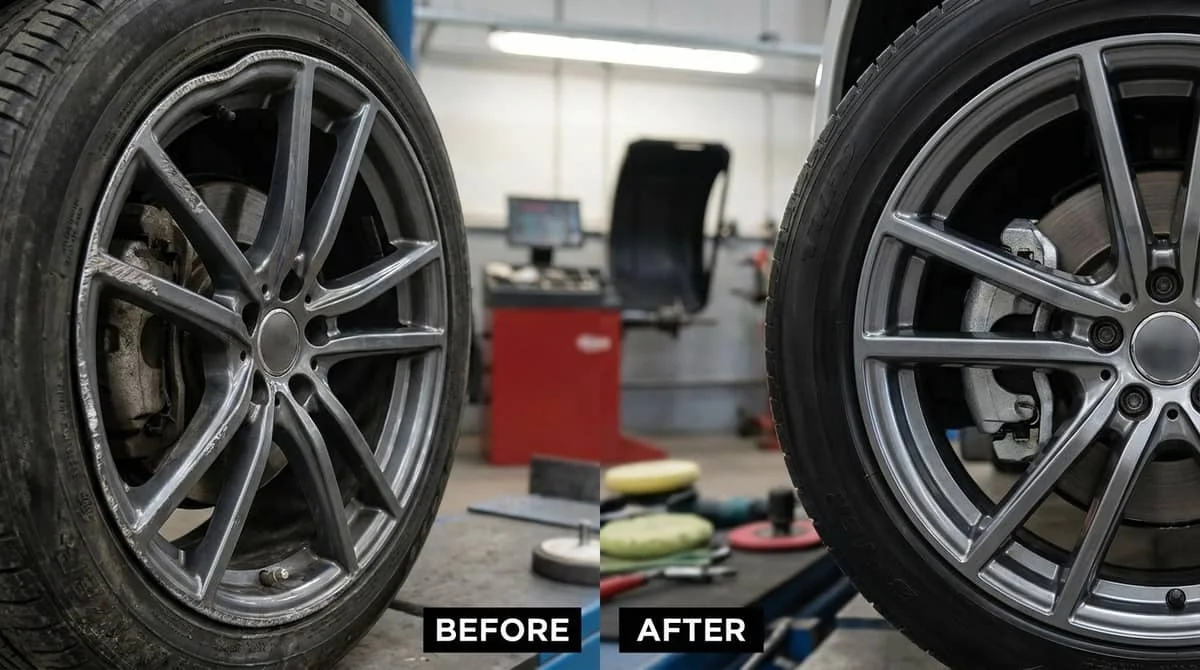
Hitting a pothole, curb, or road hazard can leave you wondering: Should I repair or replace my wheel? In many cases, a damaged wheel or rim can be safely repaired—but not every wheel should be saved.
The decision between wheel repair vs replacement depends on the type and location of the damage, the wheel material, whether the wheel is cracked or structurally compromised, and whether it can be restored to proper specifications.
A bent wheel, especially one bent from a pothole, may sometimes be straightened by a qualified professional. Minor rim repair can also be more economical than purchasing a new wheel. However, a cracked rim, severe structural damage, or a wheel that cannot be returned to a safe and accurate shape may need replacement.
This guide explains when to repair a wheel, when to replace a rim, how pothole damage occurs, what symptoms to watch for, and how to make the safest and most cost-effective decision.

Wheel Repair vs Replacement: The Quick Answer
A wheel can often be repaired when the damage is limited to a repairable bend, minor cosmetic damage, or certain types of localized deformation. A wheel should generally be replaced when it has severe structural damage, an unrepairable crack, significant material loss, or cannot be restored to safe operating condition.
The most important factors are:
- Type of wheel damage
- Location of the damage
- Severity of the bend
- Wheel material
- Presence of cracks
- Air leakage
- Structural integrity
- Ability to restore the wheel accurately
- Cost of repair versus replacement
In other words, repair or replace rim shouldn’t be decided based only on how bad the wheel looks.
What Causes Wheel and Rim Damage?
Wheel damage can happen in several ways, but potholes are among the most common causes.
Common causes include:
- Potholes
- Road debris
- Curbs
- Parking barriers
- Railroad crossings
- Uneven pavement
- Collisions
- Tire impacts
- Overloading
- Severe road hazards
A high-speed impact can transfer significant force through the tire into the wheel.
This can produce a wheel bent from pothole impact, a rim bent from pothole impact, cracked material, cosmetic damage, or damage to the tire itself.
Pothole Wheel Damage: Why It Happens
When a tire drops into a pothole and hits the opposite edge, the wheel experiences a sudden impact.
The tire absorbs some of the force, but the wheel can still deform.
This is particularly common with:
- Low-profile tires
- Large-diameter wheels
- Performance vehicles
- Stiffer sidewalls
- Lightweight alloy wheels
A bent wheel after a pothole doesn’t always look dramatically damaged.
Sometimes the deformation is only visible when the wheel is rotated on balancing equipment or inspected against a precision reference.
That’s why a wheel can appear fine while still causing vibration or air-pressure problems.
Signs of Pothole Wheel Damage
If you recently hit a significant pothole, watch for these symptoms:
- Steering-wheel vibration
- Vehicle vibration at highway speeds
- Repeated loss of tire pressure
- Slow air leakage
- Visible wheel deformation
- New tire damage
- Uneven tire wear
- Steering changes
- Wheel wobble
- Difficulty balancing the wheel
- Vehicle pulling or handling differently
These symptoms don’t automatically prove that the wheel is bent. Tire damage, wheel imbalance, alignment problems, suspension damage, and other issues can produce similar symptoms.
A professional inspection can identify the actual cause.

Can a Bent Wheel Be Repaired?
Often, Yes—but It Depends on the Damage
One of the most common questions after hitting a pothole is:
Can a bent wheel be repaired?
In many cases, a bent wheel repair can restore a wheel that has localized deformation without replacing the entire component.
A professional wheel repair process may involve carefully measuring the wheel, identifying the deformation, and using controlled equipment to return it toward its correct shape.
However, not every bent wheel is a good candidate for repair.
A repair assessment should consider:
- How far the wheel is out of shape
- Where it is bent
- Whether the wheel is cracked
- Whether the bead seat is damaged
- Whether material has been stretched or compromised
- Whether the wheel can be restored accurately
- Whether the wheel remains structurally sound
The fact that a wheel can technically be bent back does not automatically mean it should be repaired.
Safety and structural integrity come first.
Can a Bent Rim Be Repaired?
Yes, a bent rim can sometimes be repaired, particularly when the damage is localized and the wheel remains structurally sound.
This is especially relevant after:
- Pothole impacts
- Curb impacts
- Road hazards
- Minor collisions
However, professional inspection is essential for determining whether bent rim repair is appropriate.
A wheel that has a small, localized bend is very different from one that has a major crack or extensive deformation.
What Is the Difference Between Wheel Repair and Rim Repair?
In everyday automotive terminology, wheel and rim are often used interchangeably.
Technically, the rim is the outer portion of the wheel assembly that supports the tire bead, while the wheel includes the complete component, including the center and spokes.
For most consumer searches, however, terms such as:
- Rim repair
- Bent rim repair
- Wheel repair
- Bent wheel repair
refer to the same general service category.
This article uses both terms because drivers commonly search for both.
Alloy Wheel Repair: What You Need to Know
Modern vehicles frequently use alloy wheels, particularly aluminum alloy wheels.
Alloy wheels offer advantages such as:
- Lower weight
- Attractive designs
- Heat dissipation
- Performance characteristics
But aluminum and other alloy materials behave differently from steel.
Aluminum wheel repair requires specialized knowledge and equipment.
A technician must consider the specific alloy, wheel construction, deformation, and location of damage.
Steel Wheel vs Alloy Wheel Repair
| Factor | Steel Wheel | Alloy Wheel |
| Material | Steel | Aluminum alloy or other alloy |
| Common damage | Bends | Bends, cracks, cosmetic damage |
| Repair characteristics | Generally forgiving | Requires specialized assessment |
| Corrosion concerns | Yes | Yes |
| Cosmetic refinishing | Sometimes | Common |
| Crack considerations | Important | Particularly important |
| Replacement cost | Often lower | Can be significantly higher |
The material alone doesn’t determine whether a wheel is repairable.
The location and severity of damage are equally important.

When to Repair a Bent Wheel
A repair may make sense when:
- The wheel has a localized bend.
- There is no critical crack.
- The wheel remains structurally sound.
- The damage can be accurately corrected.
- The wheel can hold the tire properly.
- Repair costs are substantially below replacement.
- A qualified technician determines the wheel is safe to restore.
For example, a moderate pothole impact may bend the inner lip of an alloy wheel while leaving the rest of the wheel intact.
In a suitable case, pothole wheel repair can restore the wheel without requiring a replacement.
When to Replace a Wheel
Some Damage Is Better Left Unrepaired
Replacement becomes the better option when the wheel has damage that cannot be reliably restored.
Potential replacement situations include:
1. Severe Cracking
A significant crack can compromise structural integrity.
2. Extensive Deformation
If the wheel is severely distorted, restoring its original geometry may not be practical or safe.
3. Major Material Loss
If part of the wheel has broken away or significant material is missing, replacement may be necessary.
4. Damaged Critical Areas
Damage around important structural or mounting areas deserves particular caution.
5. Repeated Failed Repairs
A wheel that has already undergone multiple repairs may warrant replacement depending on its condition.
6. Repair Cost Approaches Replacement Cost
If a reliable repair is almost as expensive as a suitable replacement wheel, replacement may make more financial sense.
When to Replace a Rim
If you’re asking when to replace a rim, consider the following red flags:
- Visible structural cracks
- Severe deformation
- Broken sections
- Persistent air leakage after repair
- Damage around critical mounting areas
- Inability to balance the wheel properly
- Evidence that the wheel cannot be restored to correct specifications
A cosmetic blemish doesn’t automatically mean replacement is required.
A structural problem is different.
Bent Rim vs Cracked Rim: Why the Difference Matters
A bent rim and a cracked rim are not equivalent problems.
Bent rim
A localized bend may be repairable if the wheel remains structurally sound.
Cracked rim
A crack can represent a more serious structural problem and may make replacement the safer option.
The location of the crack matters, as does its size, depth, and relationship to the wheel’s structural components.
Never assume a visibly small crack is harmless.

Wheel Damage From a Pothole: What Else Should Be Checked?
A pothole impact doesn’t necessarily damage only the wheel.
The impact can also affect:
- Tire sidewall
- Tire bead
- Suspension components
- Steering components
- Wheel bearings
- Alignment
- Wheel balance
A professional inspection should therefore look at the entire affected corner of the vehicle when symptoms suggest more than cosmetic damage.
Expert Tip
If your vehicle develops a vibration immediately after a pothole impact, don’t simply assume you need wheel balancing.
A bent wheel, damaged tire, alignment issue, or suspension problem could be responsible.
Wheel Repair vs Replacement Cost
The cost of wheel repair varies significantly.
Factors include:
- Wheel diameter
- Wheel material
- Damage location
- Severity of deformation
- Wheel design
- Finish
- Extent of cosmetic damage
- Required refinishing
- Replacement wheel availability
A simple localized bend can be considerably less expensive to address than purchasing and installing a new OEM wheel.
However, price shouldn’t be the only consideration.
A repaired wheel needs to be structurally sound and capable of safely supporting the tire.
Repair or Replace Wheel: A Practical Decision Guide
Use this checklist when deciding whether to save the wheel.
Repair may make sense if:
- The wheel is bent but not severely damaged.
- There is no significant structural crack.
- The wheel can be restored accurately.
- The tire and bead seat remain serviceable.
- A qualified technician confirms repairability.
- Repair provides meaningful savings over replacement.
Replacement may make sense if:
- The wheel has severe cracks.
- A structural section is broken.
- The wheel is extensively deformed.
- Material is missing.
- Repair cannot restore proper geometry.
- The wheel repeatedly develops problems.
- Repair costs approach replacement costs.
Should I Repair or Replace My Wheel?
There isn’t a universal answer.
Instead, ask these five questions:
- Is the damage cosmetic or structural?
- Is the wheel bent, cracked, or both?
- Can the wheel be accurately restored?
- Has the tire or bead seat been damaged?
- How does the repair cost compare with a quality replacement?
If the answer to the first three questions is favorable, repair may be worthwhile.
If the wheel has major structural damage, replacement is usually the safer path.
Cosmetic Wheel Damage vs Structural Wheel Damage
Not all wheel damage is equally serious.
Cosmetic damage
Examples include:
- Curb rash
- Scratches
- Minor finish damage
- Paint or powder-coat imperfections
- Surface oxidation
Cosmetic damage primarily affects appearance.
Structural damage
Examples include:
- Bent wheel
- Severe deformation
- Cracks
- Broken sections
- Damaged bead seat
- Significant distortion
Structural damage affects the wheel’s ability to function properly.
Structural damage should always be evaluated before deciding to repair or replace the wheel.

What About Curb Rash?
Curb rash is one of the most common forms of cosmetic rim damage.
It typically occurs when the wheel contacts a curb while parking or maneuvering.
Minor curb rash may involve only the finish.
More serious curb impacts can deform the wheel itself.
That’s why a wheel with curb rash should be inspected if you also notice:
- Vibration
- Air loss
- Handling changes
- Visible deformation
A wheel can have both cosmetic and structural damage from the same impact.
Wheel Alignment vs Wheel Repair
A bent wheel and poor wheel alignment can sometimes produce similar driving symptoms, but they are different problems.
Wheel repair addresses:
- Wheel deformation
- Bends
- Certain wheel damage
Wheel alignment addresses:
- Suspension geometry
- Toe
- Camber
- Caster, depending on vehicle design
If you hit a large pothole, it may be appropriate to check both.
Repairing a bent wheel won’t automatically correct an alignment problem.
Wheel Balancing After Pothole Damage
A damaged wheel can also affect wheel balance.
If you notice vibration after hitting a pothole, a technician may inspect:
- Wheel runout
- Tire condition
- Balance
- Wheel deformation
A wheel can sometimes be balanced successfully despite damage, but that doesn’t necessarily mean the wheel is structurally healthy.
Balancing and structural wheel inspection answer different questions.
Tire Damage Should Not Be Overlooked
A pothole impact can damage the tire even if the wheel looks repairable.
Check for:
- Sidewall bulges
- Cuts
- Punctures
- Bead damage
- Uneven wear
- Loss of air pressure
A damaged tire may need replacement independently of the wheel.
This is particularly important after a severe bent wheel from pothole incident.
Can a Repaired Wheel Be Safe?
A professionally repaired wheel can be safe when the damage is suitable for repair and the repair restores the wheel appropriately.
But “repaired” should not simply mean “made to look straight.”
A proper evaluation considers:
- Structural integrity
- Wheel geometry
- Runout
- Tire seating
- Damage location
- Material condition
- Remaining deformation
This is why DIY attempts to hammer or heat a wheel back into shape can be risky.

Common Mistakes With Bent Wheel Repair
1. Continuing to Drive on a Damaged Wheel
If you notice vibration, air loss, or obvious deformation after an impact, have the wheel inspected.
2. Assuming a New Tire Fixes the Problem
A new tire won’t correct a bent wheel.
3. Ignoring Slow Air Loss
A damaged bead seat or wheel can contribute to recurring pressure loss.
4. Choosing Repair Based Only on Price
The cheapest repair isn’t necessarily the safest repair.
5. Assuming All Wheel Bends Are Repairable
Some bends are appropriate for repair; others aren’t.
6. Ignoring Cracks
A cracked wheel requires careful professional evaluation.
7. Forgetting About Suspension Damage
A major pothole impact can affect more than the wheel.
Professional Wheel Repair: What to Expect
A quality wheel repair assessment should begin with inspection rather than immediately applying force to the damaged area.
A technician should determine:
- Wheel material
- Type of damage
- Location of deformation
- Presence of cracks
- Severity of the damage
- Tire condition
- Whether the wheel remains repairable
- Whether replacement is more appropriate
This approach helps prevent unnecessary replacement while avoiding repairs that aren’t appropriate.
Insurance and Pothole Wheel Damage
Whether insurance covers pothole wheel damage depends on the policy, circumstances, and applicable coverage.
Some drivers may have coverage for certain road-hazard or collision-related losses, while other policies may exclude particular situations.
If you are considering an insurance claim:
- Photograph the wheel and tire damage.
- Document the pothole or road hazard when possible and safe.
- Keep repair estimates.
- Review your deductible.
- Check your policy’s applicable coverage.
- Ask the insurer how the damage should be documented.
For a relatively inexpensive repair, the deductible may make paying out of pocket more practical.
Does Wheel Repair Affect Vehicle Value?
A properly repaired wheel can restore the vehicle’s appearance and functionality.
This can matter when:
- Selling the vehicle
- Trading it in
- Returning a leased vehicle
- Preparing a performance vehicle for sale
Visible bent wheels, severe curb rash, or damaged finishes can make a vehicle appear poorly maintained.
However, the priority should always be safe, technically appropriate repair, not simply making the wheel look good before a sale.
Pros and Cons: Repair vs Replacement
| Wheel Repair | Wheel Replacement | |
| Cost | Often lower | Often higher |
| Original wheel retained | Yes | No |
| Good for localized bends | Yes | Not necessary |
| Good for severe cracks | Usually no | Often preferred |
| Cosmetic restoration | Often possible | New wheel starts fresh |
| Downtime | Can be relatively short | Depends on wheel availability |
| OEM matching | Existing wheel retained | Must find correct replacement |
| Best for severe structural damage | No | Yes |

Expert Tips for Pothole Wheel Damage
Tip 1: Don’t judge damage by appearance alone
A small-looking deformation can cause substantial vibration.
Tip 2: Check tire pressure
Unexpected pressure loss after a pothole is a reason to have the wheel and tire inspected.
Tip 3: Pay attention to highway-speed vibration
New vibration after an impact is an important diagnostic clue.
Tip 4: Keep the original wheel when repair is appropriate
Repairing an OEM wheel can sometimes be preferable to finding an aftermarket replacement with different specifications.
Tip 5: Ask why replacement is recommended
If you’re told to replace the wheel, ask whether the issue is cosmetic, structural, or economic.
How to Choose the Right Wheel Repair Specialist
Look for a provider that:
- Inspects the wheel before recommending repair
- Understands aluminum and alloy wheel construction
- Distinguishes cosmetic from structural damage
- Explains repair limitations
- Evaluates tire condition
- Considers wheel specifications
- Doesn’t automatically recommend replacement
- Doesn’t promise that every damaged wheel can be repaired
A trustworthy technician should be willing to tell you when not to repair a wheel.
That’s an important part of professional service.
Summary: When to Save the Wheel vs Buy a New One
So, should I repair or replace my wheel?
A bent wheel caused by a pothole doesn’t automatically need replacement. If the deformation is localized and the wheel remains structurally sound, professional bent wheel repair may restore it accurately and save the cost of a new wheel.
On the other hand, a cracked rim, severely deformed wheel, broken structural area, significant material loss, or wheel that cannot be reliably restored may need replacement.
The same principle applies to rim repair vs replacement: don’t choose based solely on appearance or price.
The correct decision considers the wheel’s material, structural integrity, deformation, tire condition, repairability, and replacement cost.
If you’ve recently experienced pothole wheel damage, a bent rim after hitting a pothole, vibration, or unexplained tire-pressure loss, professional inspection is the best way to determine whether you should repair or replace the wheel.
Frequently Asked Questions
Yes, many localized wheel bends can be professionally repaired. Whether a particular wheel should be repaired depends on the severity and location of the deformation, the wheel material, and whether the wheel remains structurally sound.
Repair may make sense when the rim has a localized, repairable bend without serious structural damage. Replacement is generally more appropriate for severe cracks, extensive deformation, broken structural sections, or wheels that cannot be safely restored.
Often, yes. Rim bent from pothole damage may be repairable when the deformation is localized and the wheel remains structurally sound. A professional inspection is necessary before determining whether repair is appropriate.
Common signs include new steering-wheel vibration, highway-speed vibration, slow tire-pressure loss, visible deformation, difficulty balancing the wheel, or changes in vehicle handling. Tire, alignment, and suspension damage can cause similar symptoms.
Some cracks may be technically repairable, but a cracked wheel can present a more serious structural concern than a simple bend. The crack’s location, severity, and wheel construction must be evaluated before deciding whether repair is appropriate. Replacement may be the safer option.
Often, yes, particularly when the wheel has a localized bend that can be professionally restored. However, the cost depends on wheel size, material, damage severity, finish, and replacement availability. Severe damage may make replacement more economical.
Yes. A severe pothole impact can damage the tire, wheel, suspension, steering components, wheel bearing, or alignment. If your vehicle develops vibration, air loss, or handling changes after an impact, have the entire affected area inspected.
You might also find our article intriguing:
- Bumper Damage: PDR, Repair, or Replacement?
- Scratches vs Dents: Polishing or Paint Repair
- PDR Myths Debunked: 7 Common Doubts Answered
Good Luck to You 🌊

