
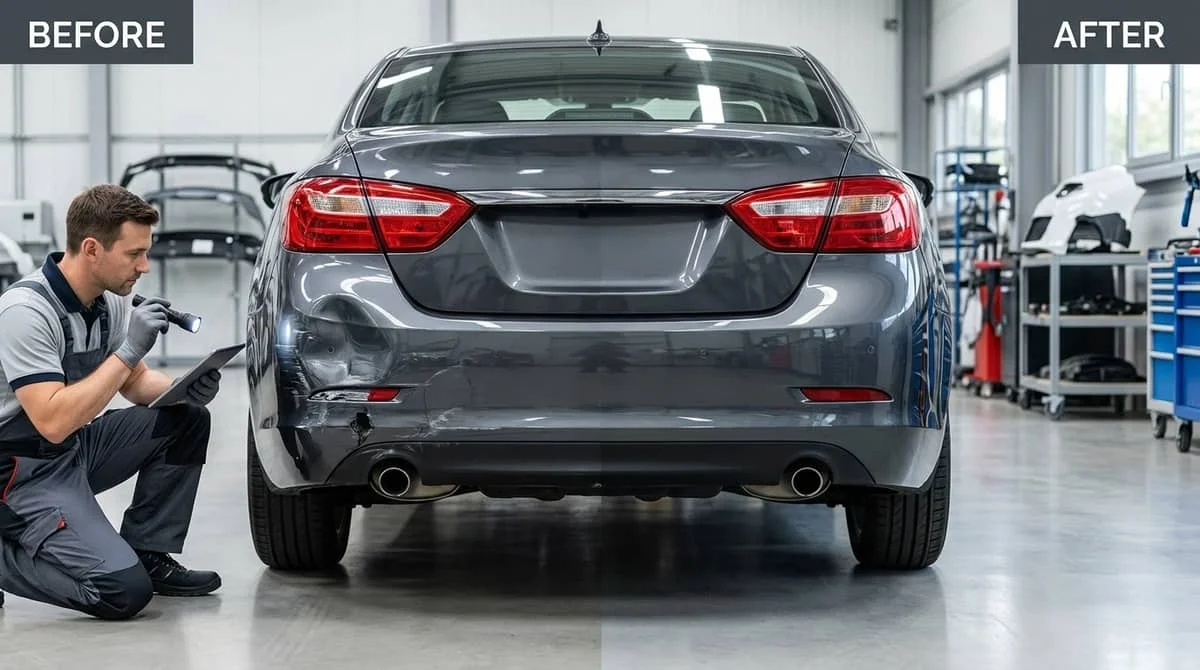
Bumper damage can range from a small parking-lot ding to a cracked or heavily deformed bumper. The right solution depends on what was damaged, how severe the impact was, whether the bumper is plastic or another material, and whether the damage affects the bumper’s structure or only its appearance.
For minor dents, professional bumper dent repair may restore the original shape without replacing the entire bumper. In some situations, specialized PDR bumper repair techniques can reshape flexible plastic without traditional bodywork. But when a bumper is cracked, split, severely deformed, or structurally compromised, bumper repair vs replacement becomes a different decision.
So, can a damaged bumper be repaired? Often, yes—but not every bumper should be repaired.
This guide explains the major bumper damage repair options, when PDR makes sense, when traditional repair is better, and when replacing the bumper is the safer and more economical choice.

What Types of Bumper Damage Can Be Repaired?
Modern vehicle bumpers are typically made from flexible plastic or composite materials and are designed to absorb energy during lower-speed impacts. Behind the visible bumper cover may also be reinforcement components, absorbers, brackets, sensors, and other systems.
That means the visible dent isn’t always the full story.
Common types of bumper damage include:
- Small bumper dents
- Parking-lot dings
- Dented bumper corners
- Plastic bumper deformation
- Scratches and scuffs
- Paint transfer
- Cracked bumpers
- Split or torn plastic
- Broken mounting tabs
- Severe bumper deformation
- Damage around parking sensors or cameras
- Collision-related bumper damage
A minor dent with intact plastic is very different from a bumper that has cracked or separated from its mounting points.
Quick Answer: Can a Damaged Bumper Be Repaired?
Yes. Many bumper dents, dings, scratches, and certain cracks can be repaired. However, severely cracked, torn, structurally compromised, or extensively deformed bumpers may require replacement.
The repair decision should be based on the bumper’s material, damage severity, paint condition, structural integrity, and the condition of components behind the bumper.
Bumper Repair vs Replacement: What’s the Difference?
The basic distinction is straightforward:
Bumper repair restores the existing bumper when its structure and material are still suitable for repair. Bumper replacement removes the damaged bumper and installs a new one.
| Damage Type | Typical Solution | Repainting May Be Needed? |
| Small bumper dent | Dent repair / reshaping | Not always |
| Minor bumper ding | Reshaping | Not always |
| Shallow scuff | Scratch repair | Sometimes |
| Paint transfer | Cleaning/polishing | Usually no |
| Deep scratch | Paint repair | Yes |
| Small plastic deformation | Professional reshaping | Depends on paint |
| Moderate crack | Plastic repair evaluation | Often |
| Large crack or split | Repair or replacement assessment | Often |
| Broken mounting points | Repair or replacement | Depends |
| Severe deformation | Replacement often considered | Yes |
| Structural/internal damage | Professional collision assessment | Often |
The cheapest option isn’t automatically the best option. A proper car bumper repair should restore both appearance and appropriate functionality.
Option 1: Bumper Dent Repair
When a Dented Bumper Can Be Reshaped
A low-speed impact can push a plastic bumper inward without actually cracking the material.
This is one of the better scenarios for dented bumper repair.
Signs that a bumper dent may be repairable include:
- The plastic isn’t cracked.
- The bumper hasn’t torn.
- Mounting points remain intact.
- The dent is localized.
- The material hasn’t been severely stretched.
- Parking sensors and other components aren’t damaged.
- The bumper can return to its original contour.
In these situations, a technician may use controlled heat and specialized tools to carefully reshape the plastic.
This is different from simply pushing the bumper outward. Professional bumper dent repair requires controlled manipulation to avoid creating high spots, waves, or additional deformation.
Can PDR Fix Bumper Dents?
Yes, But Bumper PDR Is Different From Standard Metal PDR
One of the most common questions is:
Can PDR fix bumper dents?
The answer is sometimes.
Traditional Paintless Dent Repair is primarily associated with steel and aluminum body panels. Plastic bumpers behave differently because they are flexible and respond to heat differently than metal.
For suitable damage, technicians can use specialized paintless dent repair for bumpers or plastic reshaping techniques.
The goal is similar: restore the original contour while avoiding unnecessary sanding, filler, and repainting.
However, PDR for plastic bumpers is not appropriate for every bumper dent.
Bumper PDR may be suitable when:
- The bumper is plastic.
- The material is intact.
- There is no significant crack.
- The dent is relatively localized.
- The paint isn’t extensively damaged.
- The bumper’s mounting structure is intact.
- The deformation can be safely reshaped.
Admire PDR specifically offers bumper dent repair and evaluates plastic bumper damage to determine whether reshaping is appropriate or whether another repair method is necessary.
Option 2: Traditional Bumper Repair
Some bumper damage requires more than reshaping.
Traditional bumper repair may involve:
- Plastic welding
- Plastic repair materials
- Sanding
- Filling
- Surface preparation
- Priming
- Paint matching
- Clear coating
- Refinishing
This approach becomes more relevant when the bumper has cracked paint, damaged plastic, deep scratches, or a crack that cannot be corrected through reshaping alone.

When Traditional Repair Makes Sense
Consider conventional repair when:
- The bumper is cracked but repairable.
- Plastic has separated along a manageable split.
- Deep scratches have removed material.
- Paint damage is significant.
- The bumper requires refinishing after structural repair.
- Localized damage can be repaired without replacing the complete bumper.
The goal isn’t simply to make the bumper look better. The repair should restore an appropriate shape and finish while maintaining the bumper’s intended fit.
Option 3: Bumper Replacement
When Should I Repair or Replace My Bumper?
Replacement becomes more attractive when the bumper is damaged beyond a reliable or economical repair.
Signs replacement may be appropriate include:
- Extensive cracking
- Large splits
- Major tears
- Severe deformation
- Multiple broken mounting points
- Extensive material loss
- Damage that prevents proper alignment
- Structural components behind the bumper are compromised
- Repair would cost close to the price of replacement
- Safety-related systems have been affected
A heavily damaged bumper may technically be repairable but still make more financial sense to replace.
That’s why bumper repair or replacement shouldn’t be decided from appearance alone.
Does a Bumper Dent Affect Safety?
A small cosmetic dent doesn’t necessarily mean the vehicle is unsafe.
But bumper damage can sometimes hide problems.
After a collision, inspect for:
- Misalignment
- Loose bumper sections
- Broken brackets
- Damaged reinforcement
- Crushed energy absorbers
- Parking sensor problems
- Camera damage
- Gaps between body panels
- Damage to headlights or tail lights
- Damage behind the bumper cover
Modern vehicles may contain sensors and other components in or around the bumper area. A bumper that looks acceptable externally can still have underlying damage.
If the vehicle was involved in a significant collision, a professional inspection is more important than simply repairing the visible dent.
Bumper Dent Repair Without Repainting
One major advantage of suitable bumper reshaping is the possibility of avoiding a complete repaint.
If the bumper’s plastic is intact and the existing finish remains in good condition, specialized reshaping may restore the contour without traditional refinishing.
That can mean:
- No body filler
- Less sanding
- Less refinishing
- Preservation of the existing finish
- Faster turnaround
- Lower repair complexity
However, dent repair without repainting is only appropriate when the paint and underlying material are suitable.
If the impact caused deep scratches, chipped paint, or exposed plastic, reshaping alone won’t restore the original appearance.
What About Bumper Scratches and Paint Damage?
Not every bumper problem is actually a dent.
A bumper may have:
Light scuffing
Surface-level marks may respond to professional cleaning, polishing, or scratch correction.
Paint transfer
Material from another vehicle or object may have transferred onto the bumper without removing the original paint.
Deep scratches
If the scratch penetrates the paint system, polishing may not be enough.
Exposed plastic
If the impact removes paint and exposes the underlying bumper material, refinishing may be necessary.
This distinction is important because bumper dent removal and bumper scratch repair are different services.
Plastic Bumper Repair vs Metal Panel PDR
Plastic bumpers and steel or aluminum body panels should not be treated identically.
| Feature | Plastic Bumper | Steel/Aluminum Body Panel |
| Material behavior | Flexible | Metal deformation |
| Common repair | Reshaping / plastic repair | PDR or body repair |
| Heat response | Important | Different technique |
| Cracking concern | High | Paint/metal damage more relevant |
| PDR applicability | Limited/specialized | Common for suitable dents |
| Replacement threshold | Depends on cracking/deformation | Depends on panel damage |
| Paint preservation | Sometimes possible | Often possible with PDR |
This is why an experienced technician should inspect the actual panel rather than assuming every dent can be treated the same way.

Bumper Damage Repair After a Collision
A collision can produce more than visible bumper damage.
Even a low-speed impact can affect:
- Bumper brackets
- Reinforcement components
- Absorber material
- Parking sensors
- Radar or driver-assistance components
- Headlights
- Fenders
- Trunk or hood alignment
For a minor parking impact, car bumper repair may be relatively straightforward.
For a larger collision, however, the bumper should be evaluated as part of the entire accident damage.
Expert Tip
If the bumper suddenly has unusual gaps after an impact, don’t assume it is only cosmetic.
Uneven gaps, loose mounting, or a bumper that doesn’t sit correctly can indicate broken clips, brackets, or underlying damage.
How Much Does Bumper Repair Cost?
There is no single price for bumper damage repair because repair complexity varies substantially.
Cost can depend on:
- Dent size
- Dent location
- Bumper material
- Paint condition
- Crack length
- Number of damaged areas
- Accessibility
- Broken mounting points
- Sensor involvement
- Required refinishing
- Replacement-part cost
Generally, a small bumper dent that can be reshaped is less expensive than extensive crack repair or complete bumper replacement.
A professional inspection is the best way to determine whether bumper repair vs replacement makes financial sense.
Admire PDR offers on-site bumper assessments in the Sacramento area, including evaluation of minor dents, scratches, cracks, and split bumper situations.
Does Insurance Cover Bumper Damage?
Insurance coverage depends on how the damage happened and what coverage your policy provides.
For example:
- Collision coverage may apply to damage from a covered collision.
- Comprehensive coverage may apply to certain non-collision events.
- Another driver’s liability insurance may apply when they are responsible for an accident.
- Deductibles can affect whether filing a claim makes financial sense.
Before filing a claim, consider the estimated repair cost, your deductible, and the specific terms of your policy.
For significant collision damage, documenting the damage with photographs and obtaining a professional estimate can help establish the repair scope.
Pros and Cons of Bumper Repair vs Replacement
Bumper Repair
Pros:
- Usually less expensive for suitable damage
- Preserves the existing bumper
- Can avoid unnecessary replacement
- May require less material and labor
- Can be faster for minor damage
Cons:
- Not appropriate for every crack or deformation
- Severe damage may compromise the finished result
- Paint repair may still be necessary
- Hidden damage may change the repair strategy
Bumper Replacement
Pros:
- Provides a new bumper cover
- Appropriate for severely damaged components
- Can simplify repairs when damage is extensive
- May be preferable when repair approaches replacement cost
Cons:
- Usually more expensive
- Requires installation
- May require painting and color matching
- Additional components may need transfer or replacement
- Doesn’t automatically address hidden collision damage
Common Mistakes With Bumper Damage
1. Assuming every dent requires replacement
A small plastic bumper dent may be repairable.
2. Treating a plastic bumper like a steel door
Plastic and metal respond differently to repair techniques.
3. Ignoring cracks
A crack can progress or compromise the bumper’s appearance and attachment.
4. Repairing only what is visible
Collision damage can extend behind the bumper cover.
5. Choosing the cheapest quote automatically
A lower price isn’t useful if the repair doesn’t restore proper fit, finish, or function.
6. Trying aggressive DIY heat methods
Improper heating can distort plastic, damage paint, or create additional deformation.
7. Ignoring sensors
If the vehicle has parking sensors, cameras, radar, or other systems around the bumper, they should be checked after an impact.

How to Decide the Right Bumper Repair Option
Use this simple decision process:
Step 1: Is the bumper cracked or split?
Yes: Have the damage professionally evaluated for plastic repair versus replacement.
No: Continue to the next step.
Step 2: Is it primarily a dent or deformation?
Yes: Professional bumper dent repair or specialized bumper PDR may be appropriate.
Step 3: Is the paint damaged?
Yes: Determine whether scratch correction, touch-up, or full refinishing is required.
Step 4: Are the mounting points intact?
No: Traditional repair or replacement may be necessary.
Step 5: Was there a significant collision?
Yes: Inspect the components behind the bumper before deciding on cosmetic repair.
Step 6: Does repair cost approach replacement cost?
If so, compare the long-term value of both options.
Why Professional Assessment Matters
The visible size of a bumper dent doesn’t tell the whole story.
Two dents that look identical can require completely different repairs because of differences in:
- Material
- Location
- Impact force
- Paint condition
- Plastic flexibility
- Access
- Internal components
- Mounting structure
That’s why professional bumper damage repair starts with inspection.
Admire PDR provides mobile bumper repair assessments throughout the Greater Sacramento area, including Sacramento, Elk Grove, Roseville, Folsom, Rancho Cordova, and nearby communities.
The company specializes in PDR and also evaluates bumper dents, scratches, cracks, and split-bumper situations to determine whether reshaping, specialized repair, or replacement is the appropriate path.
Summary: PDR, Repair, or Replacement?
So, should I repair or replace my bumper?
The answer depends on the damage.
Small, intact bumper dents may be good candidates for professional reshaping or specialized paintless dent repair for bumpers.
Scratches, deep paint damage, and certain cracks may require traditional bumper repair and refinishing.
Severe cracks, extensive deformation, broken mounting points, or significant underlying collision damage can make bumper replacement the better option.
The most important rule is simple:
Don’t choose the repair method based only on the size of the dent. Choose it based on the bumper’s material, structural condition, paint, mounting points, and the extent of the damage.
For Sacramento-area drivers, Admire PDR can inspect the damage and explain whether bumper dent repair, PDR bumper repair, traditional bumper repair, or replacement makes the most sense for your vehicle.
Get Your Bumper Damage Evaluated
Don’t replace a bumper that can be professionally repaired—and don’t repair a bumper that should be replaced.
Contact Admire PDR for a professional bumper damage assessment and find out what your vehicle actually needs.
With mobile service available across the Greater Sacramento area, you can have your bumper evaluated at home, work, or another convenient location.
Frequently Asked Questions About Bumper Damage Repair
Yes. Many bumper dents, dings, scratches, and certain cracks can be repaired. Severe cracks, extensive deformation, broken mounting points, or significant underlying damage may require replacement.
Sometimes. Specialized PDR bumper repair or plastic reshaping can work on suitable plastic bumper dents when the material is intact and the damage isn’t too severe. Standard metal-panel PDR techniques don’t automatically apply to every plastic bumper.
Usually, repairing suitable minor damage costs less than replacing an entire bumper. However, extensive cracks or severe deformation can make replacement more economical.
Yes, in some cases. If the plastic is intact and the paint hasn’t been significantly damaged, professional reshaping may restore the bumper without a full repaint.
It depends on the extent of the damage. A professional should check the bumper cover, mounting points, reinforcement, sensors, and components behind the bumper before making the decision.
It can. Visible cosmetic damage can reduce buyer appeal and may affect resale or trade-in value. Repairing suitable damage can improve the vehicle’s appearance and overall presentation.
Start with a professional inspection. The technician should evaluate the bumper material, dent or crack severity, paint condition, mounting points, internal components, and whether the damage can be safely reshaped or repaired. This determines whether PDR, bumper repair, or replacement is the right solution.
You might also find our article intriguing:
- Scratches vs Dents: Polishing or Paint Repair
- PDR Myths Debunked: 7 Common Doubts Answered
- What Damage PDR Can’t Fix (An Honest Guide)
Good Luck to You 🌊

