
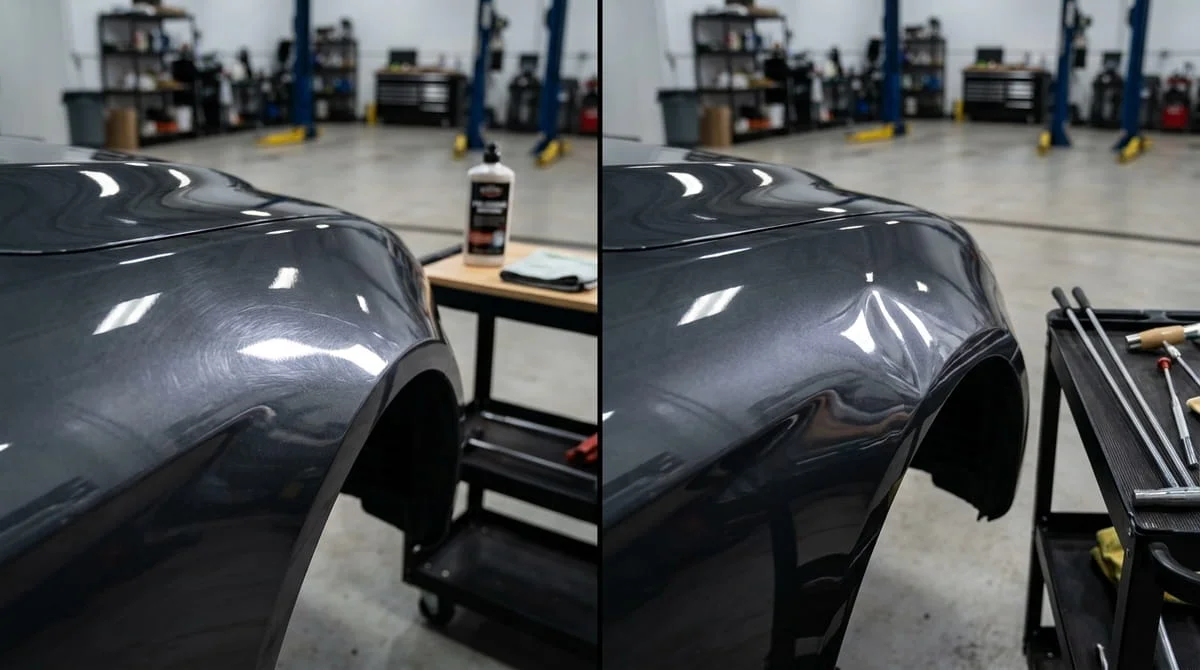
A scratch and a dent may look like similar cosmetic problems, but they damage a vehicle in fundamentally different ways. Knowing the difference between scratches and dents helps you choose the correct repair instead of spending money on the wrong service.
Surface scratches may only require polishing or paint correction, while deeper scratches can require automotive paint repair. Dents are different: they deform the vehicle’s body panel and may require Paintless Dent Repair (PDR) or traditional dent repair.
So when comparing scratches vs dents, the first question isn’t simply, “How bad does it look?” It’s “Which layer or part of the vehicle has actually been damaged?”
This guide explains when car scratch repair, polishing, paint repair, and car dent repair make sense—and when professional repair is the better option.

Scratches vs Dents: What’s the Difference?
The simplest distinction is:
A scratch damages the vehicle’s surface or paint layers. A dent changes the shape of the body panel.
A vehicle scratch can affect one or more layers of the automotive paint system:
- Clear coat
- Base coat/color
- Primer
- Bare metal
A dent, meanwhile, affects the physical shape of the panel.
Sometimes both occur together. For example, a parking lot impact may leave a dent with scratched clear coat, chipped paint, or even exposed metal on the car.
That distinction determines whether you need polishing, paint repair, PDR, or conventional bodywork.
How to Tell Whether You Have a Scratch or a Dent
Common signs of a scratch include:
- Visible lines in the paint
- Paint transfer
- Dull or hazy areas
- Scratched clear coat
- Chipped car paint
- Exposed primer
- Exposed metal
If the panel remains perfectly shaped but the surface is damaged, you’re primarily dealing with a paint problem.
A Dent Changes the Panel Shape
A dent causes the metal or body panel to move inward or outward.
Common examples include:
- Door dings
- Parking lot dents
- Hail dents
- Shopping cart impacts
- Minor collision dents
If you can see distorted reflections across the panel, there’s a good chance the metal itself has been deformed.
Understanding the Layers of Automotive Paint
Knowing the vehicle’s paint layers makes it easier to understand when does a car scratch need paint.
Clear Coat
The transparent top layer protects the color underneath.
Light scratches may exist entirely within this layer.
Base Coat
This is the colored layer that gives the vehicle its appearance.
A scratch that reaches the base coat is more serious than a clear-coat scratch.
Primer
Primer provides adhesion between the substrate and paint.
If a scratch exposes primer, polishing usually won’t restore the original color.
Metal
The deepest damage may expose bare metal.
Exposed metal should be addressed promptly because moisture and environmental contaminants can lead to corrosion.
Can You Remove Car Scratches With Polish?
Car polishing can remove or significantly reduce certain superficial scratches by leveling microscopic imperfections in the clear coat.
Polishing may help with:
- Light clear-coat scratches
- Swirl marks
- Fine surface imperfections
- Minor scuffs
- Very light paint transfer
The process is often called paint correction or scratch polishing.
However, polishing doesn’t replace missing paint.

The Fingernail Test: A Useful Initial Check
One simple way to evaluate a scratch is to gently run a clean fingernail across it.
If your fingernail barely catches:
The damage may be limited to the clear coat and potentially suitable for polishing.
If your fingernail catches significantly:
The scratch may extend deeper into the paint system.
If you see primer or metal:
Polishing won’t restore the missing material.
A professional inspection is more reliable than any DIY test, but this can provide a useful initial indication.
When to Use Polishing or Paint Correction
Polishing Is Usually Appropriate For:
- Clear-coat scratches
- Light surface marks
- Minor scuffs
- Swirl marks
- Fine oxidation
- Superficial paint imperfections
Benefits of Polishing
- No repainting
- Preserves the existing paint
- Can improve gloss
- Removes very minor surface defects
- Usually faster than refinishing
But there is an important limitation:
Polishing removes a microscopic amount of clear coat. It should not be repeatedly used aggressively in an attempt to eliminate a deep scratch.
When Does a Car Scratch Need Paint?
If the scratch has removed paint rather than simply disturbing the clear coat, car paint scratch repair may be required.
Signs include:
- Visible primer
- Bare metal
- Missing paint
- Chipped paint
- Peeling paint
- Deep paint scratches
- Significant clear coat damage
At this point, polishing cannot recreate the missing paint.
When Paint Repair Becomes Necessary
Traditional automotive paint repair may involve:
- Cleaning the damaged area
- Sanding the affected surface
- Applying primer where required
- Applying color-matched paint
- Applying clear coat
- Blending and finishing the repair
The exact process depends on the severity and location of the damage.
What About Paint Transfer?
Not every mark that looks like a scratch actually removes your paint.
Sometimes another object leaves its material on your vehicle.
Examples include:
- Rubber transfer
- Plastic transfer
- Paint transfer from another vehicle
- Road debris marks
If your factory paint remains intact underneath, professional scratch removal or paint correction may eliminate the mark without repainting.
This is why an inspection should come before assuming you need paint work.

Scratches vs Dents: What Repair Does Each Need?
| Damage | Typical Repair |
| Light clear-coat scratch | Polishing |
| Swirl marks | Paint correction |
| Light surface scuff | Polishing/scratch removal |
| Paint transfer | Cleaning/polishing |
| Base-coat scratch | Paint repair |
| Exposed primer | Paint repair |
| Exposed metal | Paint/body repair |
| Door ding with intact paint | PDR |
| Hail dent with intact paint | PDR |
| Deep dent with stretched metal | PDR evaluation or traditional repair |
| Dent with major paint damage | Body/paint repair |
| Structural collision damage | Traditional body repair |
When Should You Repair a Car Dent?
A small dent can often be repaired using Paintless Dent Repair when:
- The factory paint is intact.
- The metal hasn’t been severely stretched.
- There is no structural damage.
- The technician can access the back of the panel.
- The dent’s shape is suitable for PDR.
PDR is particularly effective for:
- Door dings
- Hail damage
- Parking lot dents
- Minor collision dents
- Shallow body panel damage
When Is PDR Better Than Traditional Dent Repair?
PDR is often preferable when a dent can be restored without damaging or replacing the original factory finish.
PDR advantages
- Preserves OEM paint
- No body filler
- Usually no repainting
- Often faster
- Maintains the original panel
- Particularly effective for hail damage
Traditional repair advantages
Traditional body repair may be more appropriate when:
- Paint is damaged
- Metal is severely stretched
- The panel is crushed
- Structural damage exists
- The panel requires replacement
The correct method depends on the condition of the vehicle—not simply the size of the dent.
Can PDR Fix a Scratch?
No. PDR and Scratch Repair Solve Different Problems.
This is an important distinction when comparing scratch and dent repair.
PDR reshapes metal. It doesn’t restore missing paint.
If a vehicle has a dent with intact paint, PDR may be appropriate.
If the same dent also has a deep scratch exposing primer or metal, additional paint repair may be necessary.
In some cases, a vehicle requires both:
PDR + paint repair
This combination is common after more significant impacts.
What About Hail Damage?
Hail damage is one of the most common applications for professional PDR.
Hailstones can create dozens of small dents across:
- Roof panels
- Hoods
- Trunks
- Doors
- Fenders
- Quarter panels
When hail leaves the factory paint intact, PDR can often restore the panels without repainting.
However, unusually severe hail can cause:
- Chipped paint
- Cracked paint
- Broken trim
- Glass damage
- Deep panel deformation
A professional hail damage repair inspection determines whether PDR alone is sufficient.
Aluminum Panels Require Specialized Repair Knowledge
Modern vehicles use aluminum for various body panels.
Aluminum can be repaired with PDR, but its characteristics differ from steel.
It may require:
- Specialized tools
- Different pressure techniques
- Greater control
- More careful analysis of metal movement
A technician should determine whether the damaged panel is steel or aluminum before establishing a repair strategy.

How Much Does Scratch and Dent Repair Cost?
There isn’t one universal price for car scratch repair or car dent repair.
Cost depends on the damage.
Scratch repair pricing factors
- Scratch depth
- Length
- Location
- Paint system
- Color complexity
- Whether blending is required
- Amount of paint damage
Dent repair pricing factors
- Dent size
- Dent depth
- Panel location
- Number of dents
- Steel versus aluminum
- Accessibility
- Metal stretching
- Repair complexity
PDR can often reduce costs
Because PDR can eliminate:
- Body filler
- Sanding
- Primer
- Paint
- Clear coat
- Paint blending
However, the cheapest method isn’t necessarily the correct method.
A proper repair should prioritize the condition of the panel and the quality of the finished result.
Does Insurance Cover Scratch and Dent Repair?
Insurance coverage depends primarily on how the damage occurred and what coverage your policy provides.
For example:
- Hail damage may fall under comprehensive coverage.
- Collision-related dents may fall under collision coverage.
- Intentional damage may fall under comprehensive coverage.
- Wear and tear typically isn’t covered.
A deductible may also make a small repair less practical to claim.
Before filing an insurance claim, compare the expected repair cost with your deductible and review your policy terms.
Common Mistakes With Car Scratch Repair
Mistake #1: Aggressively Buffing a Deep Scratch
If the scratch has reached the base coat or primer, more polishing won’t replace the missing paint.
Mistake #2: Using Coarse Abrasives Without Knowing the Paint Depth
Aggressive polishing can remove excessive clear coat.
Mistake #3: Assuming Every Scratch Needs Repainting
Many clear-coat scratches can be improved with professional paint correction.
Mistake #4: Ignoring Exposed Metal
Bare metal should not be left untreated indefinitely.
Mistake #5: Trying to Pull a Dent Without Understanding the Metal
Improper dent repair can create high spots, stretched metal, or additional panel damage.
Common Mistakes With Dent Repair
Choosing a repair method before inspecting the damage
The right solution depends on dent depth, paint condition, panel construction, and accessibility.
Treating PDR as a universal solution
PDR has limitations.
Ignoring paint damage
PDR doesn’t repair missing or damaged paint.
Waiting after a collision
Additional damage may exist beneath or behind the visible dent.
Expert Tip: Look at the Reflection, Not Just the Dent
Professional PDR technicians use specialized lighting to read subtle changes in the panel.
Why?
A panel can appear smooth from one angle while still containing:
- High spots
- Low spots
- Crowning
- Distorted body lines
Reflection quality is one of the most useful indicators of whether a repair has properly restored the panel’s contour.
This is particularly important for larger dents and hail damage.

Pros and Cons: Polishing vs. Paint Repair
| Polishing / Paint Correction | Paint Repair | |
| Best for | Surface defects | Deeper paint damage |
| Repainting | No | Yes |
| Removes clear-coat defects | Yes | Not the primary purpose |
| Restores missing paint | No | Yes |
| Preserves existing paint | Yes, when performed properly | Requires refinishing |
| Cost | Usually lower | Usually higher |
| Best for deep scratches | No | Yes |
| Best for exposed primer/metal | No | Yes |
How to Decide What Your Car Needs
Use this simple decision process:
Step 1: Is the panel dented?
Yes: Consider PDR or traditional dent repair.
No: Continue evaluating the paint.
Step 2: Does the scratch catch your fingernail?
No: It may be a clear-coat defect suitable for polishing.
Yes: It may extend deeper into the paint.
Step 3: Can you see primer or metal?
Yes: Paint repair is likely necessary.
Step 4: Is there both a dent and paint damage?
You may need a combination of dent repair and paint repair.
Step 5: Are you unsure?
Get a professional inspection before buying products or authorizing repairs.
Why Choose Admire PDR?
At Admire PDR, the repair process starts with evaluating the actual damage—not automatically recommending one repair method.
A professional assessment can determine:
- Whether the damage is a scratch or dent
- Whether PDR is appropriate
- Whether the factory paint is intact
- Whether the panel is steel or aluminum
- Whether paint correction is sufficient
- Whether traditional body repair is necessary
For eligible dents, preserving the original factory finish through PDR can be a significant advantage.
For damage that requires paint restoration, knowing that before repairs begin helps you make a better decision about cost, timing, and the final appearance.
Summary: Scratches vs Dents
The key difference between scratches vs dents is simple:
A scratch primarily affects the vehicle’s surface or paint. A dent changes the shape of the body panel.
Light scratches may respond well to car polishing, buffing, or paint correction.
Deeper scratches involving the base coat, primer, or bare metal generally require car paint repair.
Dents with intact paint may qualify for Paintless Dent Repair, particularly when they’re caused by hail, door dings, parking lot impacts, or other minor incidents.
The wrong repair method can waste money or make the damage worse. The right approach begins with identifying exactly what has been damaged.
If you’re dealing with a scratch, dent, or both, Admire PDR can evaluate your vehicle and help determine whether PDR, polishing, paint repair, or a combination of services is the appropriate solution.
Frequently Asked Questions
A scratch damages the vehicle’s paint or surface, while a dent changes the physical shape of the body panel. A single impact can cause both.
Yes, if the scratch is limited to the clear coat or is actually paint transfer or another superficial surface defect. Polishing cannot replace paint that has been removed.
A scratch generally needs paint repair when it penetrates beyond the clear coat into the base coat, primer, or metal, or when paint has chipped or peeled away.
No. Paintless Dent Repair reshapes body panels but doesn’t repair scratched, chipped, or missing paint. A vehicle may require both PDR and paint repair when a dent and paint damage occur together.
Neither is universally better. Polishing is appropriate for superficial clear-coat damage, while paint repair is necessary when paint has been removed or damaged through deeper layers.
Repair a dent when it affects the vehicle’s appearance, paint, resale value, or body panel condition. Prompt repair is particularly important when paint is chipped or metal is exposed.
Often, yes. Paintless Dent Repair is widely used for hail damage when the factory paint remains intact and the panels are suitable for PDR. Severe hail damage may require additional body or paint repair.
You might also find our article intriguing:
- PDR Myths Debunked: 7 Common Doubts Answered
- What Damage PDR Can’t Fix (An Honest Guide)
- Does Insurance Cover Paintless Dent Repair? A Step-by-Step Claims Guide
Good Luck to You 🌊

