
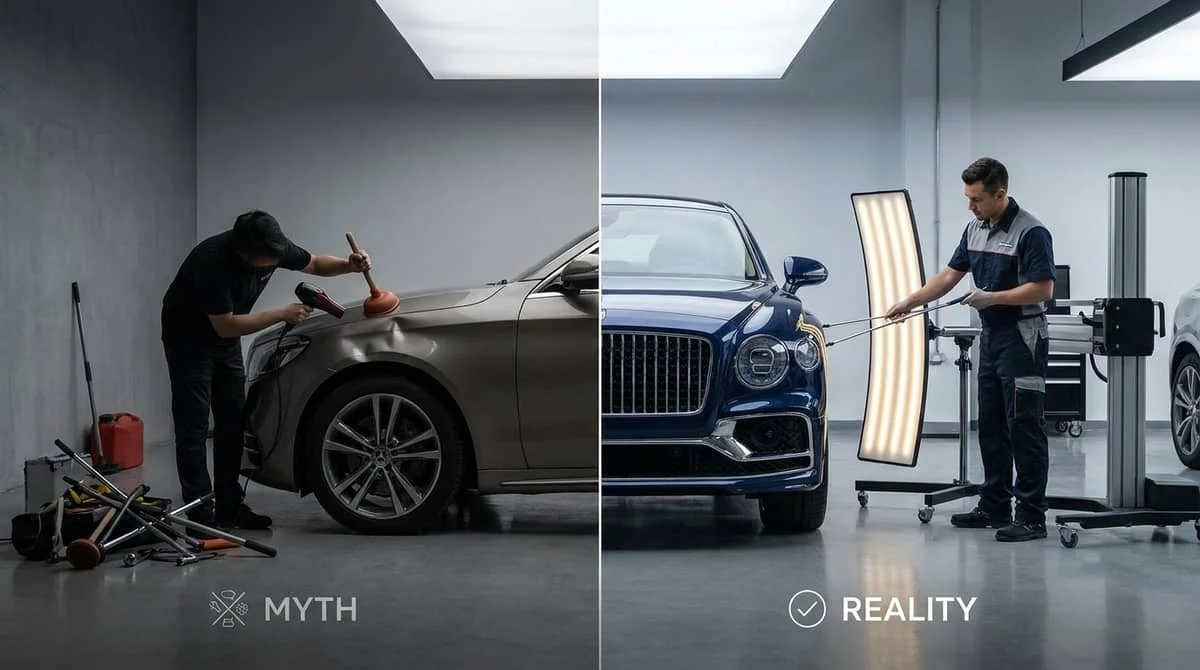
If you’ve never had a dent repaired before, it’s easy to have questions about Paintless Dent Repair (PDR). Does PDR damage paint? Is PDR safe? Can a technician really remove a dent without repainting the panel?
These questions have created plenty of PDR myths, paintless dent repair myths, and PDR misconceptions.
The truth is that professional PDR is a highly specialized form of non-destructive dent repair designed to restore certain damaged body panels while preserving the vehicle’s original finish. However, PDR isn’t appropriate for every type of damage.
In this guide, we’ll separate PDR facts vs. myths, explain the truth about Paintless Dent Repair, and answer seven of the most common doubts drivers have before choosing PDR.

What Is Paintless Dent Repair?
Paintless Dent Repair is a specialized dent removal technique that reshapes a damaged metal panel without conventional sanding, body filler, or repainting.
A trained technician uses specialized tools and controlled pressure to manipulate the backside of the panel until the metal returns as closely as possible to its original shape.
PDR is commonly used for:
- Door dings
- Parking lot dents
- Minor collision dents
- Hail dents
- Shopping cart damage
- Small creases
- Cosmetic panel damage
The primary advantage is OEM paint preservation.
Instead of removing the factory finish and applying aftermarket paint, professional PDR attempts to preserve the vehicle’s original paint.
PDR Myths Debunked: 7 Common Paintless Dent Repair Myths
Myth #1: PDR Doesn’t Really Work
Fact: PDR Can Be Extremely Effective for the Right Damage
One of the most common paintless dent repair misconceptions is that PDR is simply a temporary trick for making dents look better.
That’s not how professional PDR works.
When a dent is a suitable candidate, a skilled technician can restore the panel remarkably close to its original condition.
The key is dent eligibility.
PDR is particularly effective when:
- The paint is intact.
- The metal isn’t severely stretched.
- The dent isn’t excessively deep.
- The technician can access the damaged area.
- The panel isn’t structurally compromised.
Is Paintless Dent Repair Effective?
Yes. PDR can be highly effective when the damage is appropriate for the technique and the repair is performed by a qualified technician.
However, effectiveness depends on the dent rather than simply the size of the dent.
A relatively large, shallow hail dent may be an excellent PDR candidate, while a much smaller but extremely sharp dent may be considerably more difficult.
That’s why a professional inspection matters.

Myth #2: PDR Damages Your Factory Paint
Fact: Proper PDR Is Designed to Preserve Factory Paint
One of the biggest PDR myths is that pushing metal from behind automatically damages the paint.
Professional PDR is specifically designed to avoid that.
Technicians carefully control the movement of the metal rather than aggressively forcing the panel back into position.
The objective is to preserve:
- Factory paint
- Clear coat
- OEM finish
- Original paint adhesion
- Existing surface protection
Does PDR Damage Paint?
Professional PDR should not damage intact factory paint when the panel is a suitable candidate and the repair is performed correctly.
However, there is an important distinction.
If the paint was already:
- Cracked
- Chipped
- Peeling
- Scratched
- Delaminated
before the repair, PDR cannot restore that paint damage.
The condition of the paint must therefore be evaluated before repairs begin.
Myth #3: PDR Can Damage Any Car
Fact: Professional PDR Is a Non-Destructive Repair Method
Another common misconception is that PDR is inherently dangerous because technicians use metal rods, picks, and other specialized tools behind the panel.
The tools themselves aren’t what make PDR safe.
Technician skill, tool control, panel knowledge, and repair technique are what matter.
A professional technician understands:
- How metal responds to pressure
- Where to apply pressure
- How quickly to move the metal
- How to identify high and low spots
- How to avoid over-correcting the panel
This is why DIY dent removal and professional PDR shouldn’t be treated as equivalent.
Is PDR Safe for Your Car?
Yes. Professional Paintless Dent Repair is generally considered a safe, non-destructive repair method for eligible dents.
It doesn’t involve cutting the panel, replacing the factory finish, or permanently modifying the body panel.

Myth #4: PDR Is Only for Tiny Dents
Fact: PDR Can Repair More Than Small Door Dings
The phrase “paintless dent repair” sometimes makes people think exclusively of tiny parking lot dents.
That’s another one of the most common PDR misconceptions.
Professional PDR can sometimes repair:
- Small dents
- Medium dents
- Large shallow dents
- Multiple hail dents
- Door dings
- Creases
- Certain collision dents
- Aluminum panel damage
The determining factor isn’t simply the dent’s diameter.
Technicians evaluate:
Dent depth
A shallow dent may be easier to restore than a smaller but extremely deep dent.
Metal condition
Severely stretched metal can limit repair quality.
Paint condition
Intact factory paint significantly improves PDR eligibility.
Dent location
Some areas are much easier to access than others.
Body lines
Dents that cross strong character lines require greater precision.
Myth #5: PDR Works on Every Dent
Fact: There Are Real PDR Limitations
This is where some PDR false claims need to be corrected.
PDR is highly effective, but it isn’t magic.
There are legitimate paintless dent repair limitations.
PDR may not be appropriate for damage involving:
- Cracked paint
- Significant paint loss
- Severe metal stretching
- Crushed panels
- Structural damage
- Extreme collision damage
- Severe panel deformation
- Certain inaccessible areas
When Is Paintless Dent Repair Not an Option?
PDR may not be the right choice when restoring the metal would not produce an acceptable result or when the damage extends beyond cosmetic panel deformation.
For example, a heavily crushed panel may require conventional body repair or replacement.
Likewise, structural damage cannot be corrected simply by manipulating the outer skin.
A reputable PDR company should tell you when a different repair method is more appropriate.

Myth #6: PDR Is Always Cheaper
Fact: PDR Is Often Cost-Effective, But Not Automatically the Cheapest Option
Another popular paintless dent repair myth is that PDR always costs less than conventional body repair.
That’s too simplistic.
PDR frequently has a cost advantage because it eliminates many traditional repair steps, including:
- Body filler
- Sanding
- Primer
- Paint
- Clear coat
- Paint blending
But the actual price depends on:
- Dent size
- Dent depth
- Number of dents
- Dent location
- Metal type
- Accessibility
- Metal stretching
- Technician labor
- Overall repair complexity
PDR vs. Traditional Body Repair
| Factor | PDR | Traditional Body Repair |
| Factory paint | Usually preserved | Usually refinished |
| Body filler | No | May be required |
| Repainting | Usually no | Often required |
| Repair time | Often shorter | Often longer |
| Hail damage | Excellent application | Possible but more labor-intensive |
| Minor dents | Excellent application | Effective |
| Severe damage | Limited | Better suited |
| Structural damage | Not appropriate | Required |
The right question isn’t simply “Which repair is cheaper?”
It’s “Which repair method is appropriate for this damage?”
Myth #7: PDR Reduces Vehicle Value
Fact: Preserving the Original Factory Finish Can Be an Advantage
Many vehicle owners worry that repairing a dent without repainting will somehow make the vehicle less valuable.
In many situations, the opposite can be true.
A professional PDR repair can preserve the vehicle’s:
- Original factory paint
- OEM finish
- Factory panel
- Original appearance
Preserving original paint can be especially valuable for newer vehicles and vehicles where maintaining factory condition matters.
Why OEM Paint Preservation Matters
Factory paint is applied under controlled manufacturing conditions.
A conventional repair may require:
- Sanding the damaged area
- Applying filler
- Priming
- Color matching
- Repainting
- Clear coating
- Blending adjacent areas
PDR can avoid many of these steps when the damage qualifies.
That doesn’t mean PDR automatically increases resale value, but preserving the original finish can be preferable to unnecessary repainting.

Does PDR Crack Paint?
This question deserves a more precise answer than many generic PDR articles provide.
PDR involves controlled movement of the panel. If the paint is healthy and flexible enough for the repair, a skilled technician can manipulate the metal without damaging the finish.
However, paint already weakened by:
- Previous repairs
- Existing cracks
- Severe impact
- Poor adhesion
- Age-related deterioration
may have a higher risk of failure during any repair process.
That’s why professional inspection is essential.
A technician should identify existing paint problems before starting the repair.
Does PDR Work on Aluminum?
Modern vehicles increasingly use aluminum for:
- Hoods
- Roof panels
- Doors
- Fenders
- Quarter panels
Aluminum dent repair is possible, but aluminum behaves differently from steel.
Compared with conventional steel panels, aluminum can:
- Require more controlled manipulation
- React differently to stretching
- Have different “memory”
- Require specialized PDR techniques
A technician experienced with aluminum body panels should evaluate the damage before determining the appropriate repair method.
Can PDR Repair Hail Damage?
Hailstorms can produce dozens or even hundreds of small dents across a vehicle.
PDR is particularly useful because it can repair multiple dents while preserving the original paint.
Common hail-damaged areas include:
- Hood
- Roof
- Trunk
- Fenders
- Doors
- Quarter panels
Why PDR Works Well for Hail Damage
Hail dents are frequently:
- Shallow
- Rounded
- Paint-intact
- Distributed across large areas
That makes many hail-damaged vehicles excellent PDR candidates.
Insurance may also cover eligible hail damage under comprehensive coverage, depending on the policy and deductible.
How Professional PDR Differs From DIY Dent Repair
One reason PDR misconceptions continue to circulate is that consumers can purchase inexpensive dent repair kits online.
A professional repair is very different from simply pulling or pushing a dent.
DIY methods can create:
- Over-pulling
- Under-pulling
- High spots
- Additional creases
- Paint damage
- Stretched metal
- Uneven reflections
Professional technicians use specialized lighting to identify subtle changes in panel tension that aren’t obvious under ordinary lighting.
The Difference
DIY dent repair: attempts to make the dent disappear.
Professional PDR: analyzes the metal’s movement and progressively restores the panel’s original contour.
That distinction is critical.

PDR Pros and Cons
Advantages of PDR
- Preserves factory paint
- Avoids unnecessary repainting
- No body filler
- Often faster than conventional repair
- Excellent for hail damage
- Can preserve OEM appearance
- Often cost-effective for cosmetic dents
- Non-destructive repair approach
Limitations of PDR
- Not suitable for every dent
- Doesn’t repair damaged paint
- Can’t correct structural damage
- Severe metal stretching can limit results
- Accessibility can be a problem
- Requires specialized technician skill
Common Mistakes When Choosing Dent Repair
1. Assuming Every Dent Needs a Body Shop
Many minor cosmetic dents can be repaired without conventional bodywork.
2. Assuming Every Dent Is a PDR Candidate
The opposite mistake is equally problematic.
A professional inspection should determine eligibility.
3. Choosing Based Only on Price
The cheapest quote doesn’t necessarily represent the best repair.
4. Ignoring Existing Paint Damage
Paint damage can change the entire repair strategy.
5. Attempting Aggressive DIY Repairs
Over-pulling or excessive pressure can make professional restoration more difficult.
Expert Tips: How to Choose a PDR Technician
Look for a professional who:
- Specializes in Paintless Dent Repair
- Has experience with hail damage
- Understands steel and aluminum panels
- Explains the repair process clearly
- Evaluates paint condition
- Doesn’t promise that every dent can be repaired
- Provides realistic expectations
- Can explain PDR versus traditional body repair
The Best Sign of Expertise?
An honest technician knows when not to perform PDR.
A reputable professional should recommend conventional repair when PDR isn’t appropriate rather than forcing an unsuitable repair method.
Why Choose Admire PDR?
At Admire PDR, the goal isn’t simply to make a dent less visible.
The objective is to determine the most appropriate repair method for the vehicle and its specific damage.
A professional assessment considers:
- Dent size
- Dent depth
- Metal type
- Paint condition
- Panel accessibility
- Metal stretching
- Body lines
- Collision history
- Overall repair complexity
Whether you’re dealing with a single door ding or extensive hail damage, an accurate assessment helps you understand your options before work begins.
The Truth About Paintless Dent Repair
The biggest takeaway from these PDR myths debunked is that Paintless Dent Repair isn’t a miracle technique—and it doesn’t need to be.
It’s a specialized repair method designed for specific types of damage.
The facts are straightforward:
PDR can be highly effective.
PDR can preserve factory paint.
PDR is generally safe when performed correctly on an eligible panel.
PDR can repair many hail dents and cosmetic dents.
PDR cannot repair every type of damage.
Professional evaluation matters.
These are the paintless dent repair facts that matter when deciding how to repair your vehicle.

Summary: PDR Facts vs. Myths
| Common Myth | The Reality |
| PDR doesn’t work | PDR can be highly effective for suitable damage |
| PDR damages factory paint | Professional PDR is designed to preserve intact factory paint |
| PDR is unsafe | Properly performed PDR is a non-destructive repair method |
| PDR only fixes tiny dents | Larger shallow dents and hail damage may qualify |
| Every dent can be repaired with PDR | Severe damage may require traditional repair |
| PDR is always cheaper | Cost depends on damage and repair complexity |
| PDR hurts resale value | Preserving OEM paint can be beneficial |
Final Verdict: Is Paintless Dent Repair Safe?
Yes—professional Paintless Dent Repair is generally a safe and effective repair method for eligible dents.
The keyword is eligible.
PDR isn’t appropriate for every dent, and a trustworthy technician should never claim otherwise.
When the paint is intact, the metal isn’t excessively stretched, the panel is accessible, and there is no structural damage, PDR can provide an excellent repair while preserving the vehicle’s original factory finish.
If you’re unsure whether your dent qualifies, Admire PDR can evaluate the damage and explain whether PDR or traditional body repair is the better option.
Don’t let PDR myths determine how you repair your vehicle. Get the damage professionally evaluated and choose the repair method based on the actual condition of the panel.
Frequently Asked Questions About PDR Myths
Yes. Paintless Dent Repair is highly effective for many dents when the paint is intact and the metal hasn’t been severely stretched or structurally damaged. Results depend on dent depth, location, metal type, paint condition, and technician skill.
Yes. Professional PDR is a non-destructive dent repair technique designed to restore eligible body panels without cutting, replacing, or repainting them.
Professional PDR is designed to preserve factory paint and the OEM finish. However, existing cracked, chipped, or weakened paint may require separate refinishing.
PDR should not crack healthy factory paint when performed correctly on a suitable panel. Existing paint damage, previous repairs, or severe impact can affect the risk and repair strategy.
Improper dent removal can damage a vehicle, but professional PDR is specifically designed to minimize that risk. Technician training, controlled pressure, proper tools, and accurate damage assessment are essential.
No. Severe dents, structural damage, crushed panels, excessive metal stretching, and significant paint damage may require traditional body repair.
Neither method is universally better. PDR is often preferable for eligible cosmetic dents because it preserves factory paint and avoids unnecessary refinishing. Traditional body repair is more appropriate for severe damage, damaged paint, structural problems, or panels that cannot be effectively restored with PDR.
You might also find our article intriguing:
- What Damage PDR Can’t Fix (An Honest Guide)
- Does Insurance Cover Paintless Dent Repair? A Step-by-Step Claims Guide
- How to Maintain Your Car After Dent Repair
Good Luck to You 🌊

