
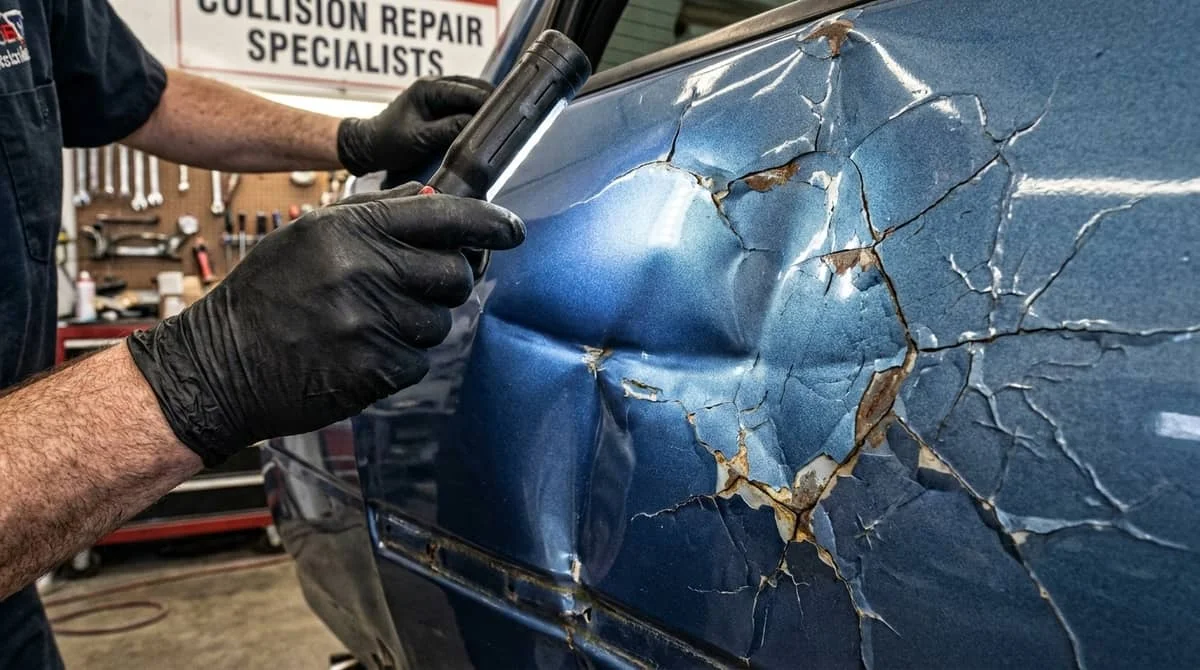
Can all dents be fixed with PDR?
This is one of the most common questions drivers ask after discovering vehicle damage.
The answer is simple:
No.
Although Paintless Dent Repair is one of the most effective methods for restoring minor vehicle damage, there are clear PDR limitations.
Many dents caused by hail, parking lot accidents, shopping carts, and door dings can often be repaired without affecting the original paint. However, some damage extends beyond the capabilities of Paintless Dent Repair.
Knowing when paintless dent repair is not an option can save you time, money, and frustration.
This guide explains:
- Dents that can’t be repaired with PDR
- Paintless dent repair limitations
- Situations where PDR fails
- When dent repair requires repainting
- When to choose traditional dent repair

How Paintless Dent Repair Works
Before discussing limitations of Paintless Dent Repair, it’s important to understand the repair process.
PDR is a specialized technique that restores damaged body panels without:
- Sanding
- Body filler
- Priming
- Repainting
Instead, technicians use specialized tools to carefully reshape the metal from behind the panel while preserving the original factory finish.
PDR works exceptionally well for:
- Door dings
- Parking lot dents
- Minor creases
- Shopping cart dents
- Hail damage
- Cosmetic dents
However, several factors determine paintless dent repair eligibility.
Five Factors That Determine Whether a Dent Qualifies for PDR
Professional technicians evaluate every dent according to five primary criteria.
1. Paint Condition
Is the paint still intact?
Paint condition is often the most important factor.
2. Metal Stretching
Has the impact permanently stretched the metal?
3. Dent Depth
How deep is the dent?
4. Dent Location
Can technicians physically access the damaged area?
5. Impact Severity
Did the damage affect only the outer panel, or did it extend into structural components?
These five factors determine whether the damage qualifies for Paintless Dent Repair.
Cracked Paint Is One of the Biggest PDR Limitations
Can PDR Repair Cracked Paint?
No.
PDR repairs metal.
It doesn’t repair paint.
Damage that usually disqualifies a panel from Paintless Dent Repair includes:
- Cracked paint
- Chipped paint
- Peeling paint
- Damaged clear coat
- Scratched vehicle paint
- Paint damage after impact
Why Paint Damage Changes Everything
Once paint breaks, the panel loses its protective barrier.
This allows:
- Moisture intrusion
- Oxidation
- Corrosion
- Rust formation
If the impact exposes bare metal, delaying repairs can result in:
- Surface rust
- Paint delamination
- Body panel deterioration
In these situations, paint restoration becomes necessary.
Traditional repairs typically involve:
- Sanding
- Primer
- Paint matching
- Clear coat application

Deep Dents May Exceed PDR Capabilities
Can PDR Fix Deep Dents?
Sometimes.
However, deep dents are among the most challenging repairs.
The deeper the impact, the greater the likelihood of:
- Metal stretching
- Paint stress
- Surface distortion
- Permanent deformation
Severe Dent Repair Limitations
Not all dents maintain their original metal characteristics after an impact.
Severe dents often exceed the metal’s natural memory.
Signs of over-stretched metal include:
- Wrinkled surfaces
- Distorted reflections
- Uneven contours
- Permanent deformation
These stretched metal dents may improve with PDR, but perfect restoration isn’t always possible.
Sharp Dents and Creases Create Significant Challenges
Unlike smooth dents, sharp dents compress metal into a very small area.
This creates:
- Higher stress concentrations
- Greater metal fatigue
- Increased paint compression
Sharp impacts frequently damage both the metal and the paint.
Body Line Damage Is More Difficult to Repair
Vehicle body lines aren’t simply decorative.
They provide:
- Structural reinforcement
- Additional rigidity
- Improved panel strength
Unfortunately, body line damage is far more difficult to repair.
Because these areas are reinforced, technicians have less flexibility when reshaping the metal.
Some bodyline dents can be repaired successfully.
Others exceed the practical limits of PDR.

Collision Damage Often Requires Traditional Repairs
When PDR Won’t Work
Collision damage frequently involves more than visible dents.
A low-speed accident can affect:
- Reinforcement beams
- Adjacent panels
- Mounting points
- Door structures
- Internal supports
The visible dent is often only one part of the damage.
Structural Damage Cannot Be Repaired With PDR
Structural damage automatically changes the repair strategy.
Examples include:
- Bent support components
- Frame damage
- Impacted reinforcement members
- Misaligned structural panels
PDR isn’t designed to correct these problems.
Instead, repairs may require:
- Structural straightening
- Welding
- Component replacement
- Conventional body repair
Crushed Panels and Extensive Body Damage
Paintless Dent Repair depends on the ability to reshape metal.
When panels become crushed or folded, reshaping is no longer practical.
Examples include:
- Crushed doors
- Folded quarter panels
- Severely damaged fenders
- Roof collapse
These repairs usually require panel replacement.
Extensive Body Damage Creates Multiple Repair Challenges
Extensive body damage often involves:
- Panel deformation
- Paint failure
- Structural damage
- Trim damage
- Misalignment
Multiple repair procedures may be necessary.

Limited Access Creates Additional Dent Repair Restrictions
Tool Access Is Essential
Professional PDR technicians work behind the damaged panel.
However, certain locations contain:
- Reinforcement braces
- Adhesives
- Structural supports
- Double-wall construction
These obstacles create significant dent repair restrictions.
Common Hard-to-Access Areas
Examples include:
- Roof rails
- Rocker panels
- Door edges
- Quarter panel corners
Limited access doesn’t automatically eliminate PDR, but it significantly affects repair complexity.
Aluminum Panels Have Different Repair Requirements
Modern vehicles increasingly rely on aluminum body panels.
Although aluminum repair is possible, aluminum behaves differently than steel.
Aluminum:
- Doesn’t flex as easily.
- Retains deformation differently.
- Requires specialized equipment.
- Demands greater repair precision.
Improper repairs can permanently distort the panel.
This is why aluminum dents should always be evaluated by an experienced technician.
Repairable vs. Non-Repairable Dents
| Dent Type | PDR Candidate |
| Door dings | Excellent |
| Parking lot dents | Excellent |
| Hail dents | Excellent |
| Minor creases | Good |
| Deep dents | Possible |
| Sharp dents | Limited |
| Body line damage | Limited |
| Cracked paint | No |
| Structural damage | No |
| Crushed panels | No |
| Extensive collision damage | No |
When to Choose Traditional Dent Repair
Traditional Repair Is Usually Better When:
- Paint is damaged.
- Metal is over-stretched.
- The dent is extremely deep.
- Structural damage exists.
- The panel is crushed.
- Corrosion has developed.
Traditional repairs may include:
- Body filler
- Sanding
- Primer
- Paint matching
- Clear coat application
- Panel replacement
Knowing when to choose traditional dent repair ensures better long-term results.

Common Mistakes Drivers Make
Avoid these common mistakes.
Assuming all dents qualify for PDR
Every dent is unique.
Ignoring paint damage
Exposed metal can quickly develop rust.
Waiting too long
Delaying repairs often increases costs.
Attempting DIY repairs
Unsuccessful repairs can permanently stretch the metal.
Choosing repairs based solely on price
The cheapest repair isn’t always the best repair.
Expert Tips From PDR Specialists
✔ Schedule a professional dent inspection.
✔ Repair chipped paint quickly.
✔ Address hail damage immediately.
✔ Preserve the original factory finish whenever possible.
✔ Understand whether your vehicle uses steel or aluminum panels.
✔ Compare all available repair methods.
✔ Ask for a complete repair assessment before authorizing repairs.
Why Drivers Trust Admire PDR
An honest evaluation is just as important as the repair itself.
At Admire PDR, every vehicle undergoes a complete inspection that considers:
- Paint condition
- Dent depth
- Metal stretching
- Collision damage
- Panel accessibility
- Repair costs
If Paintless Dent Repair isn’t the right solution, technicians will recommend the most effective repair strategy for your vehicle.
Summary
Understanding what damage PDR can’t fix helps drivers make informed repair decisions.
While Paintless Dent Repair is highly effective for many cosmetic dents, there are clear PDR limitations.
Generally, dents that can’t be repaired with PDR include:
- Cracked paint
- Chipped paint
- Deep dents
- Sharp dents
- Stretched metal dents
- Structural damage
- Crushed panels
- Extensive collision damage
The best way to determine paintless dent repair eligibility is through a professional evaluation.
If you’re uncertain whether your vehicle qualifies for PDR, contact Admire PDR for an honest assessment and personalized repair recommendation.
Frequently Asked Questions
No. Paintless Dent Repair works best when the paint remains intact, and the metal hasn’t been severely stretched.
Dents involving cracked paint, severe metal stretching, structural damage, and crushed panels often require traditional body repair.
No. PDR restores metal but cannot repair damaged paint or clear coat failure.
PDR may not be appropriate when damage includes deep dents, structural problems, significant paint damage, or severe panel deformation.
Minor collision dents sometimes qualify. Major collisions typically require conventional body repair.
A professional inspection evaluates dent depth, paint condition, panel accessibility, and metal stretching.
Not always, but traditional repairs usually involve more labor, materials, and refinishing procedures, making them more expensive in many cases.
You might also find our article intriguing:
- Does Insurance Cover Paintless Dent Repair? A Step-by-Step Claims Guide
- How to Maintain Your Car After Dent Repair
- Why DIY Dent Repair Often Fails
Good Luck to You 🌊

