
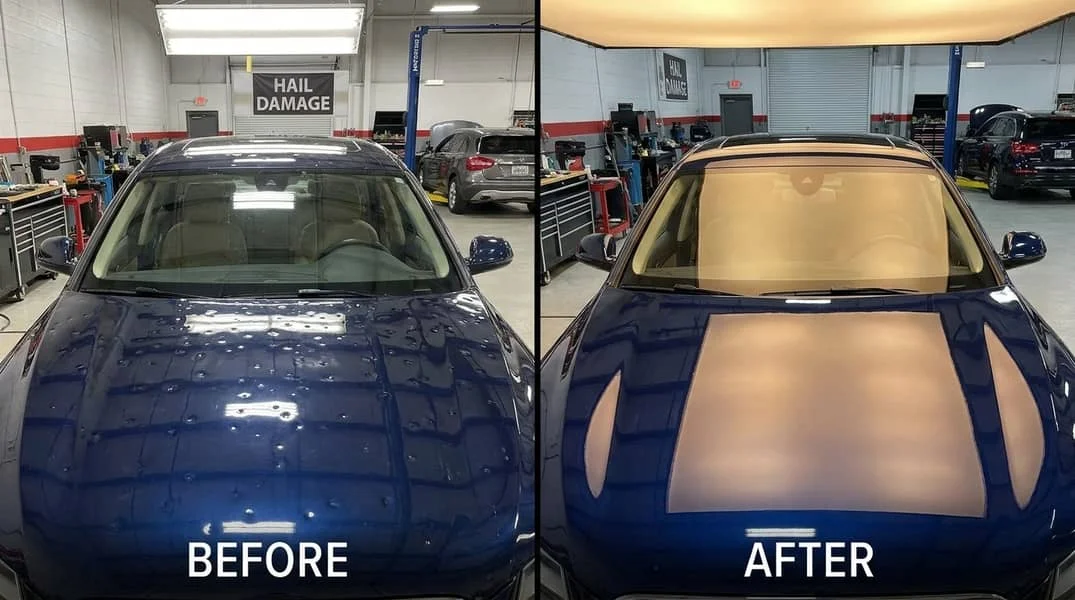
This hail damage repair before and after case study demonstrates real results achieved through professional hail damage repair case study methods using advanced paintless dent repair hail damage techniques. When a vehicle suffers hailstorm vehicle damage, owners often face hundreds of dents across panels, making hail dent removal case study analysis essential to understand real-world outcomes. This real hail damage repair example highlights full hail damage restoration before and after, showing how hail dent repair can restore a heavily car damaged by hail back to near-original condition through hail damage PDR process and dent removal without repainting.
Vehicle Overview: Hailstorm Vehicle Damage
The subject of this hail damage repair case study involved a mid-size vehicle severely impacted by a sudden storm. The vehicle hail damage included:
- Roof panel dents
- Hood impacts
- Trunk surface dents
- Multiple door panel dimples
This level of hailstorm vehicle damage is typical in severe weather events and requires professional hail damage restoration techniques.
The vehicle was evaluated for storm damage repair using a full inspection process.
Damage Assessment: Car Damaged by Hail
When a car damaged by hail arrives for inspection, technicians assess:
- Dent depth and size
- Paint condition
- Panel accessibility
- Metal stretching
In this hail dent removal case study, all dents were shallow and suitable for paintless dent repair for hail damage, making non-destructive hail repair possible without repainting.

Repair Method: Paintless Dent Repair Hail Damage
The chosen method was paintless dent repair hail damage, also known as PDR hail repair, which is the industry standard for restoring hail-damaged vehicles without affecting factory paint.
Why PDR was selected:
- Preserved factory paint
- No repainting required
- Cost-efficient solution
- Faster turnaround
- Maintained vehicle value
The hail damage PDR process focused on restoring metal from behind the panel using specialized tools.
Step-by-Step Hail Damage Restoration
The automotive hail repair procedure included:
1. Initial Inspection
Detailed mapping of all dents across panels.
2. Dent Access
Access points were created for precision tool entry.
3. Metal Reshaping
Technicians performed careful hail dent removal using controlled pressure.
4. Non-Destructive Refinement
The non-destructive hail repair method ensured factory paint remained intact.
5. Finishing Work
Final refinements ensured smooth surface restoration.
This hail damage restoration before and after process is standard for professional hail repair specialists.
Before Repair: Severe Hail Damage
Before repair, the vehicle showed:
- Dozens of visible dents
- Uneven panel reflections
- Extensive roof and hood damage
- Multiple small impact marks
This stage represents the true hail damage repair before and after challenge, where cosmetic integrity is heavily compromised.
After Repair: Hail Damage Repair Results
After completing hail dent removal, the hail damage repair results were highly successful:
- Panels restored to original shape
- Factory paint fully preserved
- No visible dent traces
- Smooth reflective surface restored
The final before and after hail damage repair comparison shows near-factory condition restoration.
Paintless Dent Repair Hail Damage Effectiveness
Paintless dent repair hail damage is one of the most effective solutions because:
- Dents are typically shallow
- Paint remains intact
- Metal retains memory
- No filler or repainting needed
This makes hail damage PDR process the preferred method for modern hail damage restoration.

Professional Hail Dent Removal Results
The work performed by hail repair specialists demonstrated:
- High precision dent removal
- Complete panel restoration
- No repainting required
- Preserved OEM finish
This professional hail dent removal outcome confirms the efficiency of non-destructive hail repair.
Cost and Time Efficiency
Compared to traditional body shop methods, this storm damage repair approach provided:
- Faster turnaround
- Lower repair cost
- No paint matching issues
- Reduced vehicle downtime
This highlights why paintless hail damage restoration is widely preferred.
Before and After Hail Damage Repair Comparison
The hail damage repair before and after transformation clearly shows:
- From heavily dented panels
- To fully restored surfaces
- Without repainting or fillers
This hail dent repair success story demonstrates real-world PDR effectiveness.
Why Non-Destructive Hail Repair Works Best
The success of this non-destructive hail repair case comes from:
- Precision tool control
- Factory paint preservation
- Metal reshaping expertise
- Advanced lighting systems
These factors ensure reliable hail damage repair results in most cases.
If your vehicle has hail damage, contact Admire PDR for a professional inspection and discover how paintless dent repair can restore your car to pre-storm condition quickly and efficiently.
Conclusion: Real Hail Damage Repair Results
This hail damage repair case study proves that paintless dent repair hail damage is one of the most effective solutions for restoring vehicles affected by severe storms. The hail damage restoration before and after comparison shows that even heavily hailstorm vehicle damage can be repaired without repainting using PDR hail repair techniques.
For most car damaged by hail situations, professional hail repair specialists can deliver outstanding before and after hail damage repair results while preserving factory paint and vehicle value.

FAQ: Case Study – Hail Damage Repair (Before & After)
Hail damage repair is the process of removing dents and restoring a vehicle after a hailstorm. Depending on the severity of the damage, repairs may involve paintless dent repair for hail damage or traditional body shop methods.
Yes. In many cases, paintless dent repair hail damage techniques allow technicians to perform dent removal without repainting. If the factory paint remains intact, PDR is often the preferred solution.
The hail damage PDR process typically includes:
1. Vehicle inspection
2. Dent mapping and assessment
3. Panel access preparation
4. Precision dent removal
5. Final quality inspection
This method is considered a non-destructive hail repair process because it restores the metal without sanding, fillers, or repainting.
Paintless dent repair for hail damage is extremely effective when dents are shallow and paint has not been damaged. Professional technicians can often remove dozens or even hundreds of hail dents while preserving the original factory finish.
A successful hail damage repair before and after transformation typically shows:
– Smooth panel surfaces
– Restored reflections
– No visible dents
– Preserved factory paint
Many vehicles appear nearly identical to their pre-storm condition after professional PDR.
The timeframe for hail dent repair depends on the number and severity of dents. Minor repairs may take one day, while extensive vehicle hail damage can require several days to complete properly.
For most cosmetic hail damage, yes. Paintless hail damage restoration offers:
– Faster repair times
– Lower repair costs
– No repainting
– Factory paint preservation
– Higher resale value retention
Traditional repairs are usually only necessary when paint or structural damage is present.
You might also find our article intriguing:
- Cheap Dent Repair vs Professional PDR: Is It Worth It?
- PDR vs DIY Dent Repair Kits: What Works Better?
- PDR vs Traditional Dent Repair: Pros & Cons
Good Luck to You 🌊

