
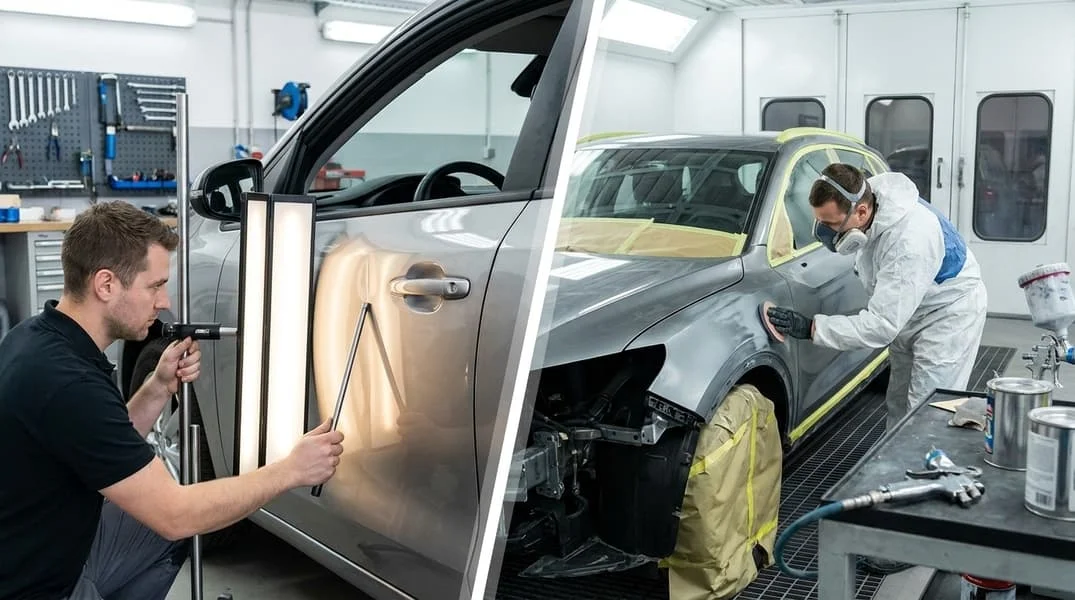
Understanding whether I need PDR or traditional dent repair is essential when choosing between PDR vs traditional dent repair and evaluating paintless dent repair vs traditional repair options. The right choice depends on the severity of the dent, the condition of the paint, and whether you want dent repair without repainting or a full restoration. In most cases, drivers compare which dent repair method is best based on cost, time, and whether they prefer PDR or body shop repair for their vehicle.
A proper paintless dent repair comparison vs traditional dent repair comparison helps determine the correct repair path and avoid unnecessary repainting or overpaying for collision repair services.
What Is Paintless Dent Repair?
What is paintless dent repair refers to a non-invasive dent repair method that restores dents without sanding, fillers, or repainting. The paintless dent removal process preserves factory paint and maintains the original vehicle finish.
Key benefits:
- Preserve factory paint with PDR
- Faster repair times
- Lower cost than body shop repair
- Ideal for PDR for minor dents
This makes PDR a preferred option when evaluating dent repair options.

What Is Traditional Dent Repair?
What is traditional dent repair involves reshaping damaged panels using fillers, sanding, and repainting. It is commonly performed in a body shop, dent repair, or full auto body repair process.
Traditional repair includes:
- Body filler and repainting
- Panel sanding and refinishing
- Structural dent repair (if needed)
This method is required when damage exceeds PDR limitations.
PDR vs Traditional Dent Repair Comparison
The core PDR vs traditional dent repair decision depends on dent type and paint condition.
Paintless dent repair vs traditional repair:
- PDR → no repainting, non-invasive, faster
- Traditional → repainting, filler, structural correction
This paintless dent repair comparison shows why PDR is preferred for cosmetic damage, while traditional repair is used for severe cases.
When Is PDR the Best Option?
When PDR is appropriate depends on dent size, depth, and paint condition.
PDR is best for:
- Minor dents and door dings
- Parking lot damage
- Shallow dents without paint damage
- Flexible metal panels
These conditions allow dent repair without repainting while preserving the factory finish.
Can PDR Fix My Dent?
The question of whether PDR can fix my dent depends on structural factors.
PDR works when:
- Paint is intact
- Metal is not stretched
- Dent is shallow or rounded
However, dents too severe for PDR require traditional repair methods.
When Traditional Dent Repair Is Needed
Traditional repair is required for:
- Sharp crease dent repair
- Stretched metal dent repair
- Paint damage and dent repair cases
- Structural dent repair situations
These cases require body shop dent repair using fillers and repainting.

Dent Size and Repair Options
Choosing between dent repair options depends on:
- Dent size and depth
- Paint condition
- Panel location
General rule:
- Small shallow dents → PDR
- Large or damaged dents → traditional repair
This helps determine how to determine dent repair method accurately.
Mobile Paintless Dent Repair Advantage
Mobile paintless dent repair provides convenience by allowing technicians to perform PDR for minor dents on-site.
Benefits:
- Faster service
- Lower cost
- No shop visit required
- Same-day repairs
This reinforces the advantages of non-invasive dent repair.
Paint Damage and Dent Repair Decisions
If paint is cracked or missing, paint damage and dent repair typically requires traditional body shop methods.
Key indicators:
- Cracked paint
- Exposed metal
- Deep creases
In these cases, PDR cannot safely restore the panel.
Collision Repair vs PDR
Collision repair services address structural damage, while PDR focuses on cosmetic restoration.
Differences:
- PDR → cosmetic dents only
- Collision repair → structural and paint damage
This distinction is key when choosing PDR or body shop repair.

Not sure whether you need PDR or body shop repair?
Contact Admire PDR for a professional assessment and find the most cost-effective solution for your dent repair needs.
Choose the Right Dent Repair Method for Your Vehicle
So, do I need PDR or traditional dent repair? If your vehicle has minor dents, shallow impacts, or door dings with intact paint, paintless dent repair vs traditional repair strongly favors PDR due to cost, speed, and factory finish preservation. However, for deep dents, sharp creases, or paint damage, traditional repair is necessary.
Understanding PDR vs traditional dent repair and evaluating dent repair options ensures you choose the correct method based on real damage conditions.
For expert evaluation and honest recommendations on which dent repair method is best, Admire PDR provides professional inspections and both PDR and repair guidance.
FAQ: Do I Need PDR or Traditional Dent Repair?
It depends on the damage. Whether I need PDR or traditional dent repair is determined by dent size, depth, and paint condition. If the paint is intact and the dent is shallow, PDR vs traditional dent repair usually favors paintless repair. If there is paint damage or structural issues, traditional repair is required.
The main difference in paintless dent repair vs traditional repair is that PDR removes dents without repainting, while traditional repair uses fillers, sanding, and repainting. This makes PDR vs traditional dent repair a faster and more cost-effective option for minor damage.
Yes, but only in certain cases. Can PDR fix my dent? It depends on whether the paint is intact and the metal is not stretched. PDR is best for shallow dents, door dings, and minor impacts without paint damage.
When PDR is appropriate is usually when dents are small, shallow, and located on accessible panels. It works best for PDR for minor dents, including parking lot damage and door dings.
You should choose traditional repair when there is:
– Cracked or damaged paint
– Deep creases or sharp dents
– Stretched metal
– Structural damage
In these cases, body shop dent repair or collision repair services are required.
Yes, one of the main advantages of paintless dent repair is that it allows you to preserve factory paint with PDR. This helps maintain vehicle value and avoids repainting.
Yes, mobile paintless dent repair is a convenient option for minor dents. It allows technicians to perform non-invasive dent repair on-site, often with same-day service depending on the damage.
You might also find our article intriguing:
- How Paintless Dent Repair Works (Step-by-Step)
- Are Small Dents a Big Problem?
- How to Prevent Dents on Your Vehicle
Good Luck to You 🌊

