
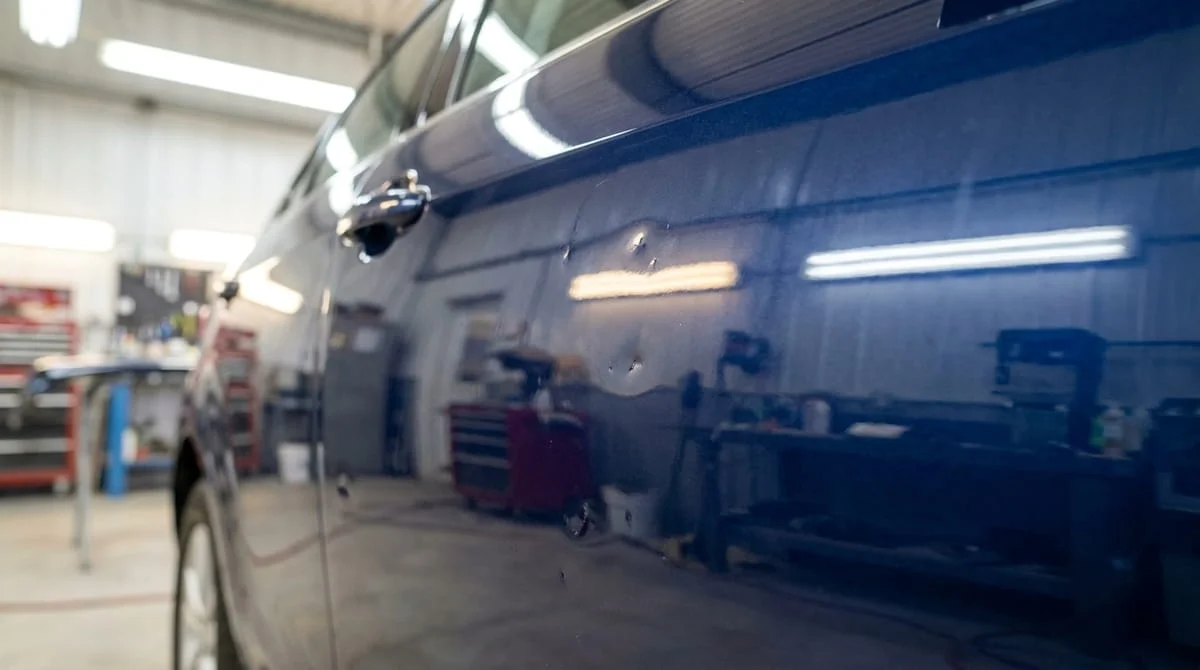
Understanding what dents PDR can fix is essential for anyone evaluating the types of dents PDR can repair and whether their vehicle qualifies for dents repairable with paintless dent repair. The question of what types of dents can be fixed with PDR depends on paint condition, dent shape, and metal elasticity. In most cases, paintless dent repair is eligible for dents with minor to moderate damage where the factory finish is intact, making dents suitable for paintless dent repair ideal for dent repair without repainting and preserving factory paint with PDR.
What Is Paintless Dent Repair?
To understand which dents qualify for PDR, you need to know what paintless dent repair is and how PDR works.
Paintless Dent Repair Explained
The paintless dent removal process is a non-invasive technique that restores vehicle panels without sanding, fillers, or repainting. This non-invasive dent repair method focuses on reshaping metal from behind the panel.
Key concept:
- Dent repair without repainting
- Factory paint preservation
- Structural metal correction
This is why paintless dent repair is typically eligible for dents that are typically those with intact paint and flexible metal memory.
Types of Dents PDR Can Repair
What dents can PDR fix?
The most common types of dents PDR can repair include everyday cosmetic damage that has not compromised paint integrity.
Dents suitable for PDR:
- Door ding repair
- Parking lot dent repair
- Minor dent repair
- Round dents PDR
- Shallow dent repair
- Soft dent repair
These are the most common dents repairable with paintless dent repair because they do not involve structural damage or paint cracks.

Common Dent Categories Suitable for PDR
1. Hail Damage Repair PDR
Hail damage repair PDR is one of the most frequent applications of PDR. Small, shallow impacts across multiple panels are ideal for non-invasive dent repair.
2. Door Ding Repair
Door ding repair is highly compatible with PDR because dents are usually shallow and paint remains intact.
3. Body Line Dent Repair
Body line dent repair is more complex but still possible when metal flexibility allows controlled reshaping.
4. Aluminum Panel Dent Repair
Aluminum panel dent repair is possible but more difficult due to reduced metal memory compared to steel.
Can PDR Fix Large Dents?
The answer depends on severity and structure. While some can PDR fix large dent cases, most large dents exceed safe repair limits.
Factors affecting large dent repair:
- Metal stretching
- Depth of impact
- Paint condition
In many cases, dents suitable for paintless dent repair are smaller or moderately sized.
Dent Types That Are NOT Suitable for PDR
Dents PDR cannot fix
There are clear paintless dent repair limitations when evaluating which dents qualify for PDR.
Problematic dent types:
- Deep dents and PDR limitations
- Sharp dents repair limitations
- Cracked paint dent repair
- Stretched metal dent repair
- Severe structural deformation
Severe cases:
- Severe collision damage repair
- Multi-panel distortion
These situations require traditional body repair.
Why Some Dents Cannot Be Repaired with PDR
Structural and paint limitations
Not all damage qualifies for dents repairable with paintless dent repair due to:
- Loss of paint elasticity
- Metal stretching beyond repair memory
- Sharp impact force concentration
When these conditions exist, non-invasive dent repair is no longer effective.
Dent Shape and PDR Success Rate
Round dents vs sharp dents
- Round dents PDR → high success rate
- Shallow dent repair → ideal conditions
- Sharp dents → higher risk of paint cracking
Dent shape is one of the most important factors in determining what dents PDR can fix.
Aluminum vs Steel Dent Repair
Material differences
- Steel panels → easier for paintless dent repair, eligible dents
- Aluminum panels → more challenging due to stiffness
This impacts the types of dents PDR can repair significantly.

When Traditional Body Repair Is Needed
You should choose conventional repair when:
- The paint is cracked
- The dent is too deep
- Metal is stretched
- Structural damage exists
In these cases, dent repair without repainting is not possible.
Not sure if your damage qualifies as types of dents PDR can repair?
Contact Admire PDR for a professional assessment and find out whether your vehicle falls under paintless dent repair eligible dents or requires alternative repair methods.
What Types of Dents Can Be Fixed with PDR?
So, what types of dents can be fixed with PDR? Most minor and moderate cosmetic dents—such as door dings, hail damage, parking lot dents, and shallow impacts—are excellent candidates for paintless dent repair eligible dents. However, dents PDR cannot fix include deep, sharp, or structurally damaged areas.
For professional evaluation of which dents qualify for PDR, Admire PDR provides expert inspection and determines whether your vehicle is suitable for dent repair without repainting or requires traditional repair.
FAQ: What Types of Dents Can Be Fixed with PDR?
Paintless dent repair (PDR) can fix most minor cosmetic dents, such as door dings, parking lot dents, hail damage, and shallow round dents. These are considered dents suitable for paintless dent repair because the paint remains intact and the metal has not been severely stretched.
Sometimes, but not always. Can PDR fix large dents depends on the depth, location, and whether the metal is stretched. Large but shallow dents may qualify, but severe damage usually requires traditional repair.
Which dents qualify for PDR includes dents where:
– The paint is not cracked or chipped
– The dent is shallow or moderate
– The metal is not stretched
– There is no structural damage
These are considered paintless dent repair eligible dents.
Dents PDR cannot fix include:
– Deep dents with stretched metal
– Sharp or heavily creased dents
– Cracked paint dents
– Severe collision damage
In these cases, when traditional body repair is needed, repainting or panel repair is required.
Yes, hail damage repair PDR is one of the most common applications of paintless dent repair. Most hail dents are shallow and do not damage paint, making them ideal for non-invasive dent repair.
Yes, door ding repair is one of the easiest and most common types of PDR. These dents are usually small, round, and located on flat panels, making them perfect for dent repair without repainting.
Yes, but it is more challenging. Aluminum panel dent repair requires specialized tools and techniques because aluminum is less flexible than steel, but many dents are still repairable depending on severity.
You might also find our article intriguing:
- Does Insurance Cover Paintless Dent Repair?
- Is It Worth Fixing Small Dents Before Selling Your Car?
- Can Paintless Dent Repair Damage Car Paint?
Good Luck to You 🌊

